DeepSeek is a strong reasoning model, but you cannot hand it an episode. It will listen to you ask a question, and it will read a PDF you attach — yet a two-hour podcast or an mp4 has nowhere to go, and the API exposes no transcription endpoint. The missing piece is a conversion step: turn the recording into text first, then let DeepSeek do what it is good at. BibiGPT is that step — paste a link or a local file, get a timestamped transcript, chapter summaries and notes. Since DeepSeek open-sourced its agent harness on 2026-08-13, you can also install BibiGPT into it as a skill, so the agent runs both halves on its own.
DeepSeek Harness · open-sourced 2026-08-13 Installs as the /bibi skill Transcript · chapters · summary
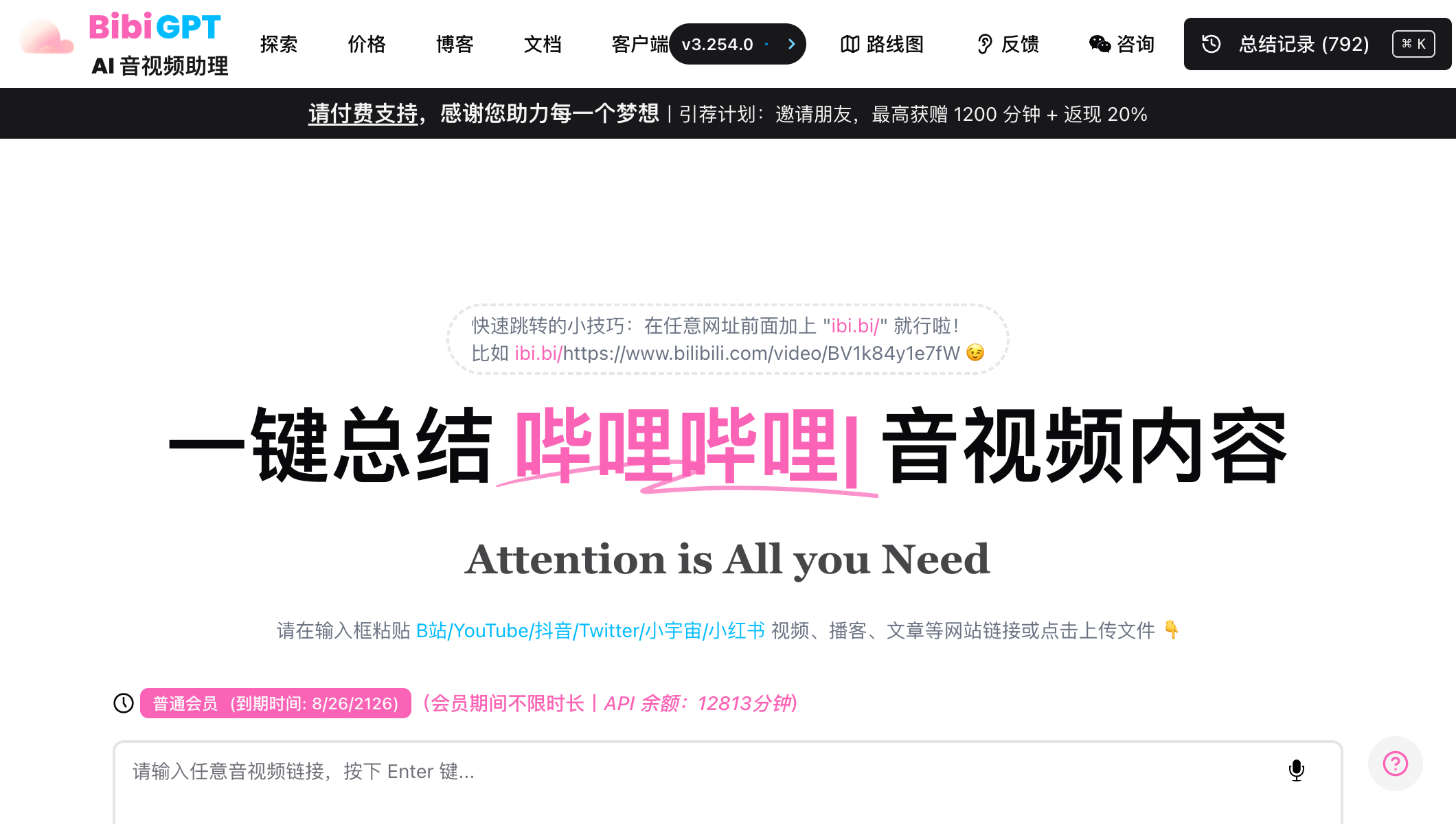
Turn a recording into text right here
Paste a podcast, lecture or video link — the transcript and chapter summaries come back in seconds, ready to hand to DeepSeek. The live BibiGPT app loads inline; no redirect.
DeepSeek cannot transcribe audio or video on its own — there is no upload for it and no transcription endpoint to call. Convert first, then hand it the text. BibiGPT does the converting: paste a link or a local file, get a timestamped transcript, chapter summaries and notes. And since DeepSeek open-sourced its agent harness on 2026-08-13, BibiGPT can be installed into it as a skill, so the agent does the fetching, the converting and the reasoning in one go.
Features
Why DeepSeek alone cannot do this
Nothing here is a knock on the model. It is a plumbing gap: the input DeepSeek accepts and the format your content is in do not line up.
Text in, text out
DeepSeek's chat app has no audio or video upload, and its API exposes no transcription endpoint. Whatever you want it to reason about has to arrive as text.
A link is not the content
Pasting a YouTube or podcast URL into a chat gives the model a string of characters, not the two hours of talking behind it. It will happily guess from the title — which is exactly the failure you want to avoid.
No prompt fixes a missing input
People try longer instructions, role-play, even asking the model to "listen carefully". The fix is upstream: convert the recording to text, then send the text.
What BibiGPT hands over
One paste turns a recording into the three things a reasoning model actually needs: the words, where they were said, and the shape of the whole thing.
Full transcript with timestamps
Export as SRT or VTT when you need the timing, plain text when you just need the words, or Markdown when it is going into Notion or Obsidian.
Chapter-by-chapter summaries
A long recording comes back split into sections with a summary per section, so you can feed DeepSeek the part you care about instead of an undifferentiated wall of text.
Links and local files both work
YouTube, Bilibili, podcasts, TikTok, X and Xiaohongshu links go in directly, and so does an audio or video file sitting on your disk.
Install it into DeepSeek Harness (3 steps)
DeepSeek Harness (dsh) is DeepSeek's open-source agent harness, MIT-licensed and currently a developer preview. Launch it with npx @deepseek-ai/dsh web. The steps below add BibiGPT to it — one command, nothing to clone.
1
Add the plugin to a profile
dsh plugin --profile web add "github:JimmyLv/bibigpt-skill#path:/dsh-plugin" — keep the quotes, since # starts a comment in the shell. dsh hands the argument to pnpm, and pnpm can install a package straight out of a subdirectory of a git repo, so there is nothing to publish and nothing to clone. Use --profile tui or --profile headless to target those instead.
2
Or skip the plugin entirely
The harness also reads skills off disk: drop the skills/bibi folder into ~/.agents/skills/ and it is picked up with zero dependencies. That directory is shared with other SKILL.md-aware agents, so one copy serves Claude Code and DeepSeek Harness at the same time.
3
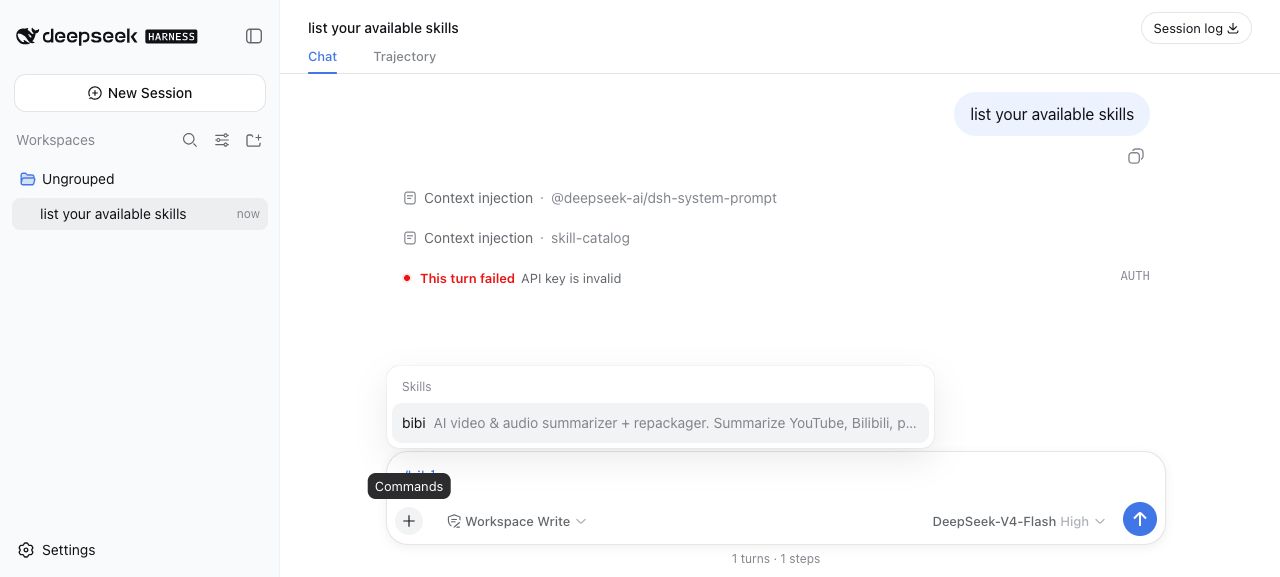
Restart and call /bibi
Restart the profile, open the command palette and look under Skills — /bibi is there. Give it a link and ask for a summary, a transcript or chapter notes; it fetches, converts and hands the text back into the conversation.
Skill installed vs doing it by hand
Both paths end with DeepSeek reading a transcript. They differ in how many windows you touch to get there.
Step
BibiGPT skill inside DeepSeek Harness
Manual, no skill
Getting the recording
Paste the link into the conversation
Download the video or rip the audio yourself
Turning it into text
The agent calls the skill and waits
Upload to some transcription service, wait, download the file
Getting it into DeepSeek
Already in the conversation
Open the transcript, copy it, paste it, hope it fits
Chapters and timestamps
Come back with the transcript
Rebuild them by hand, or go without
Repeating it for 20 episodes
Same one instruction, in a loop
Twenty rounds of the above
Three ways people use it
The common thread: the reasoning was never the bottleneck — getting the recording into a readable shape was.
Students and researchers — lectures into notes
A ninety-minute lecture becomes a timestamped transcript split into chapters. Feed DeepSeek the section you are stuck on and argue with it about that, instead of pasting an hour of raw text and hoping.
Creators — a viral clip into a draft
Pull the transcript off a short video, then have DeepSeek restructure it into a script, a thread or a newsletter. The transcript keeps the phrasing that made the clip work, which a summary would have flattened.
Agent builders — put the step inside the loop
With the skill installed, an agent running in DeepSeek Harness can take a link, get the text and act on it without a human copying anything. That is what turns a one-off into a nightly job over a whole feed.
Sources
Everything on this page about DeepSeek Harness comes from the project itself.
DeepSeek Harness — DeepSeek's open-source agent harness, MIT-licensed, developer preview, built on Cordis, published 2026-08-13.
No. DeepSeek's app has no audio or video upload and its API has no transcription endpoint, so there is nothing to send a recording to. To get audio into DeepSeek you convert it to text with a separate transcription tool first, then paste or pipe that text into the conversation.
What is DeepSeek Harness?
DeepSeek Harness, or dsh, is DeepSeek's open-source agent harness, published on GitHub on 2026-08-13 under the MIT licence and labelled a developer preview. It is built on Cordis and organised so that everything is a plugin, which is how outside capabilities such as reading a video get added to it.
What is an agent skill?
A skill is a folder holding a SKILL.md file whose frontmatter tells an agent what the skill does and when to reach for it. DeepSeek Harness discovers skills from disk, including the shared ~/.agents/skills directory, so the same folder can serve several SKILL.md-aware agents at once.
Loved by creators, students & researchers
Why people use BibiGPT to turn videos into text every day.
Trusted by 50,000+ users worldwide
★★★★★
“I paste a link and get clean captions in seconds — it saves me hours of retyping every single week.”
Maya R.
Content Creator · Repurposes short videos
★★★★★
“Exporting the transcript lets me review new words at my own pace instead of pausing the video constantly.”
Daniel K.
Language Learner · Studies with real videos
★★★★★
“Accurate, timestamped text I can quote directly. It has quietly become part of my daily workflow.”
Priya S.
Researcher · Cites public talks
FAQ'S
Frequently Asked Questions
Ask us anything!
More Free Tools
Explore our other browser-based tools — all free, no signup required.
Turn the recording into text, then let DeepSeek think
Paste a link or drop a local file — transcript, timestamps and chapter summaries come back in seconds, ready to hand to DeepSeek. Free to try, no signup needed.