Claude Opus 5 Is Here: Will a Stronger Model Make AI Video/Podcast Summaries Better?

Here’s the conclusion up front: every time a model gets a notch stronger, the “ceiling” for summary quality rises a little — but what actually determines the summary you get in practice is usually not the model, it’s what you feed it and how you feed it. Claude Opus 5 is powerful, but if all you feed it is a broken, incomplete transcript, even the smartest model can’t summarize information you never gave it.
Try it with BibiGPT first: paste a video or podcast link and get a timestamped summary in seconds
In July 2026, Anthropic released its new flagship model, Claude Opus 5. As the latest variable in the ongoing “which AI summarizes best” question, it’s worth a close look. But the more valuable question isn’t “how strong is Opus 5” — it’s exactly where a stronger model can push audio/video summarization forward, and where it can’t.
What Claude Opus 5 Actually Brings: The Facts First
As of 2026-07-27, based on the official Anthropic announcement and kie.ai’s breakdown, here’s what’s publicly known about Claude Opus 5:
- Very long context: supports a 1-million-token context window (the default is also the max), meaning it can “read in” extremely long material in one pass.
- A higher reasoning tier: a new higher reasoning-effort setting, willing to spend more compute to fully work through complex problems.
- Thinking enabled by default: reasoning traces are on by default, making it more stable on complex tasks.
- Pricing unchanged from the previous generation: priced the same as the previous Opus — a capability bump with no price increase.
For anyone doing audio/video summarization, the most notable part is that 1-million-token context window — in theory, reading through hours of long-form video or an entire podcast season in one pass is no longer a problem.
Practical rule: When a new model announces “bigger context,” don’t get excited too fast. Context is about “how much it can read,” not “whether what it reads is correct.” You still have to make sure the text you feed it is complete and accurate in the first place.
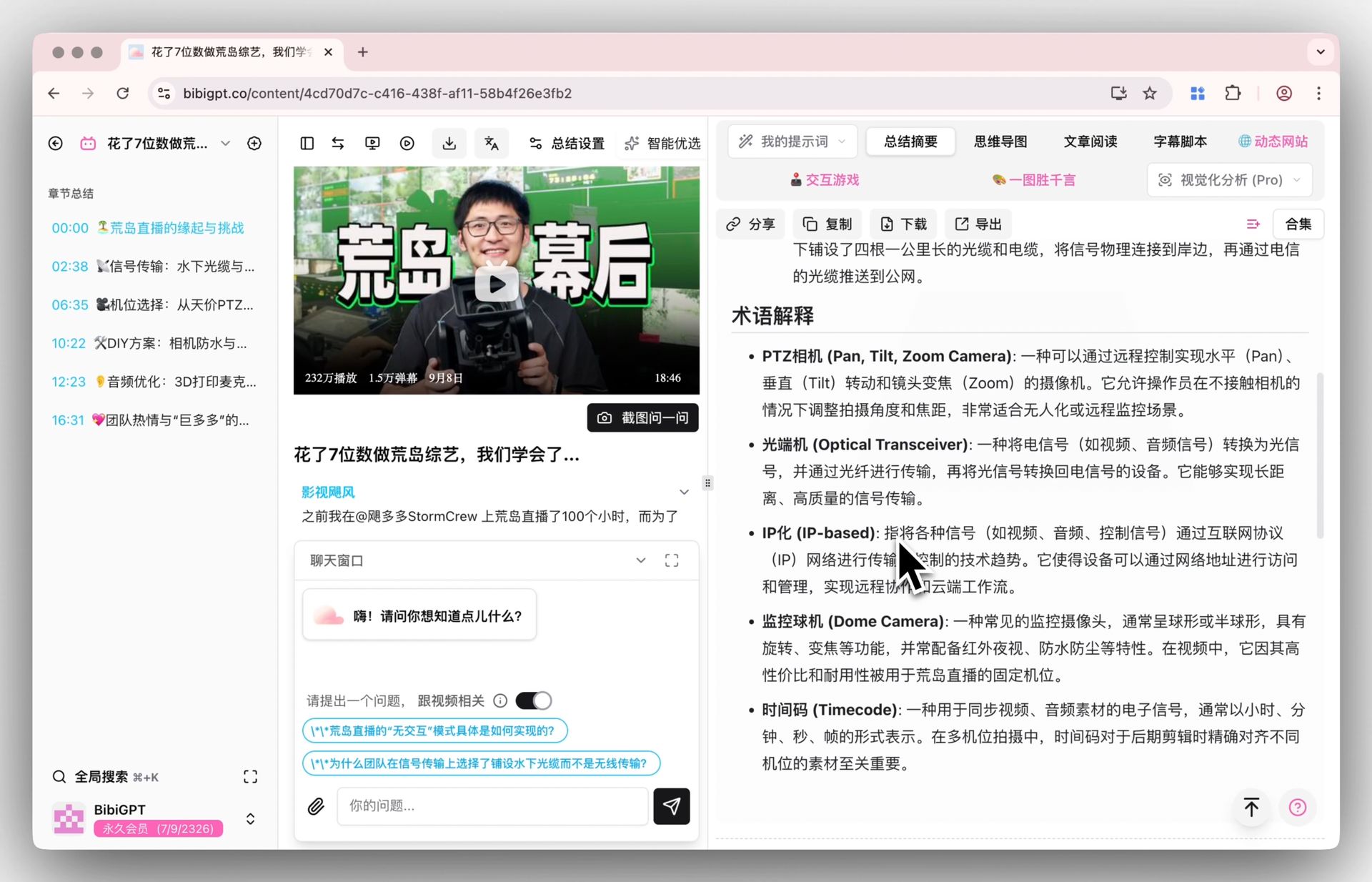
Screenshot: BibiGPT · Smart Deep Summary
Does a Stronger Model Automatically Mean a Better Summary?
The answer: it raises the ceiling, but it doesn’t guarantee what you actually get is better.
Think of summarization as a pipeline: acquire the content → convert it into accurate text → the model understands it → output structured key points. The model only handles the third and fourth steps. If the first two steps go wrong — half the video’s captions are missing, the podcast transcription mishears key terminology, only the first ten minutes of an hours-long piece got captured — then no matter whether step three runs on Opus 5 or anything else, the result won’t be much good.
That’s exactly why so many people switch to a “stronger model” and still feel the summaries haven’t improved: the bottleneck was never at the model step to begin with.
Practical rule: Summary quality = min(content completeness, transcription accuracy, model capability). It’s a “the weakest link sets the ceiling” product — no matter how strong the model is, it can’t make up for a missing piece earlier in the chain.
What Actually Determines Summary Quality (It’s Not the Model)
Based on the pipeline above, what really determines whether the summary you get is good comes down to three commonly overlooked things:
- Whether the content was fully captured: can an hours-long livestream or an entire series be ingested completely in one pass, rather than just a clipped segment.
- Whether the transcription is accurate and timestamped: mixed languages, technical jargon, multi-speaker conversations — if the transcript is wrong, the summary inherits that error; without timestamps, you have no way to check whether the model is “making things up.”
- Whether it’s traceable back to the source: a good summary should let you click a line and jump straight back to the exact second in the original video to verify it isn’t hallucinating.
Model capability obviously matters, but it’s an “amplifier” that only kicks in once those three things are already done right — get them right, and a strong model like Opus 5 adds real polish; get them wrong, and even Opus 5 can’t help.

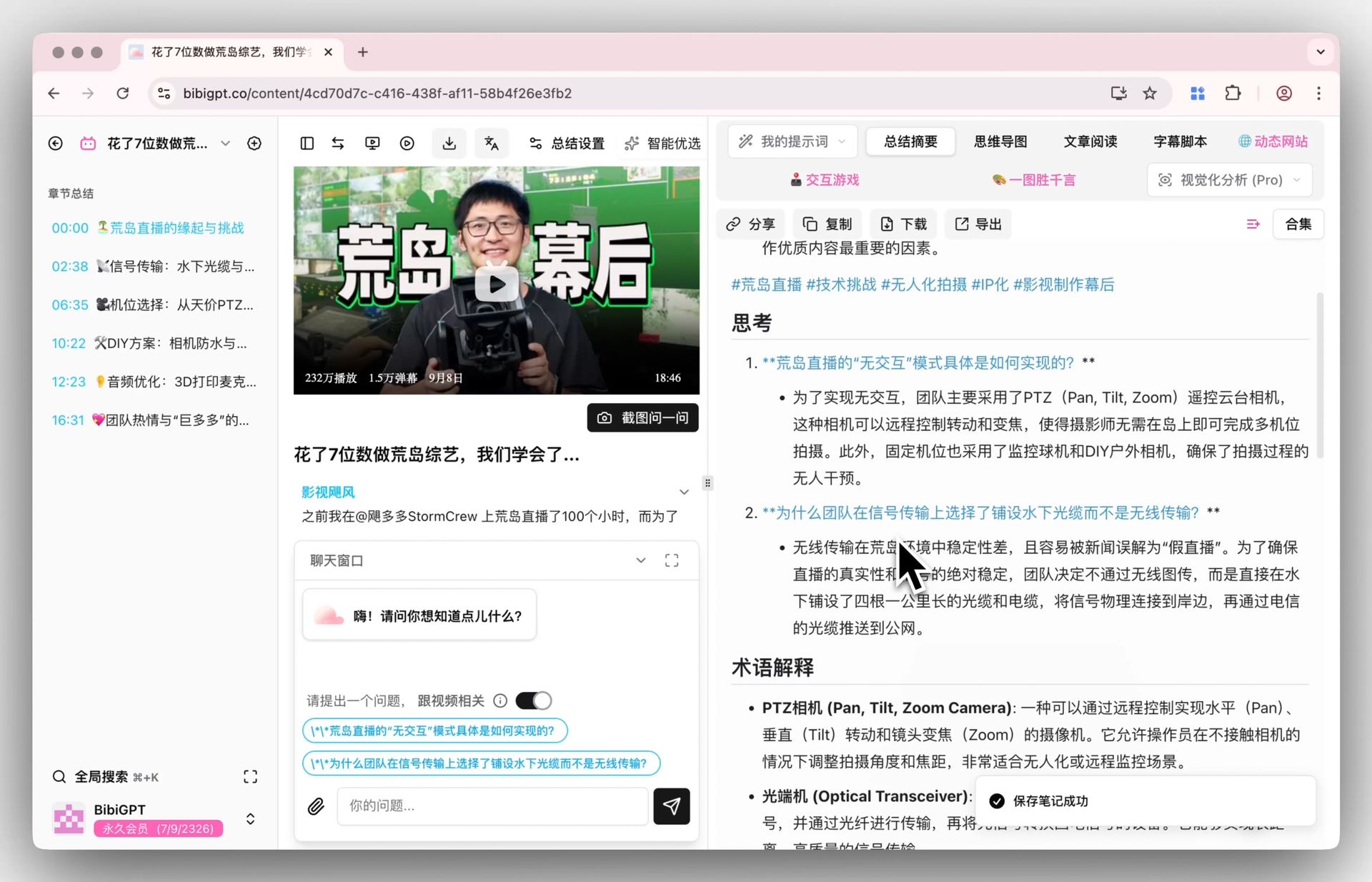
Screenshot: BibiGPT · Chapter Deep Reading
Where a Smarter Model Pays Off Most in Summarization
If you have access to a stronger model like Opus 5, here’s where it delivers the most value:
- Overall synthesis of long-form material: a 1-million-token context is best suited to tasks with huge scope, like “read an entire podcast season in one pass and produce a cross-episode narrative.”
- Breaking down complex arguments: for logic-dense content like technical talks or financial analysis, a higher reasoning tier can untangle causal chains more clearly.
- Comparing and merging multiple videos: putting a series or multiple sources together and surfacing where they agree and where they diverge.
BibiGPT supports switching freely between several leading AI models — you can pick a faster one or a stronger one depending on the difficulty and length of the content. Its value isn’t about “which model it uses” — it’s about laying that pipeline (fully capturing content, accurate transcription, timestamps, traceability) so that any strong model can perform at its full potential. BibiGPT has now served over 1 million users and generated more than 5 million AI summaries, covering 30+ mainstream audio/video platforms.
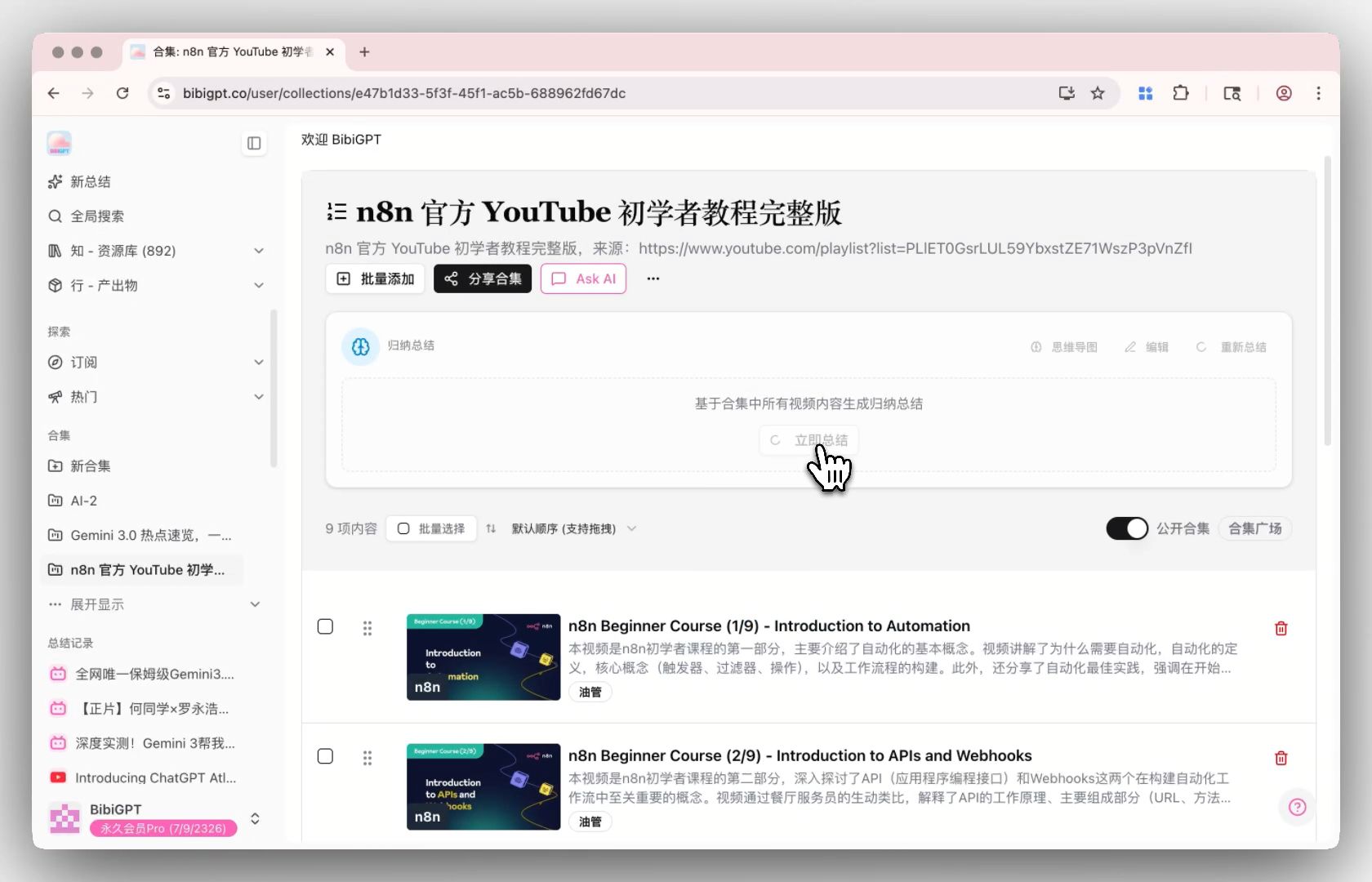
Screenshot: BibiGPT · Collection Summary
Practical Advice for Different Users
- Students / researchers: for long lectures or paper walkthroughs, prioritize “fully ingested + timestamped” first, then use a strong model for cross-chapter synthesis, so it’s easy to go back and verify citations.
- Professionals / finance users: for logic-dense content, use a higher reasoning tier, and focus on whether the model got the causal chain right — verify with a summary you can jump back to the source from.
- Content creators: merge an entire series into one summary to spot content gaps; how strong the model is matters less than making sure you captured all the content.
Try the demo below to get a direct feel for the full “paste a link in, get a structured summary out” experience:
Summarize any video in seconds
Pick a sample below to see the AI summary — TL;DR, key points, and jump-to timestamps.
TL;DR: Karpathy builds a GPT-style language model from scratch in code, explaining every piece — from a tiny character-level model up to the full Transformer.
Key points
- Start with a bigram model, then add self-attention so tokens can "talk" to each other
- A Transformer block = multi-head attention + feed-forward + residual connections + layer norm
- Training is just predicting the next token; scale and data do the rest
- The same architecture behind nanoGPT is what scales up to ChatGPT
Jump to
- 00:07 Why build GPT from scratch
- 08:23 Self-attention, intuitively
- 1:00:00 Assembling the Transformer block
- 1:35:00 From nanoGPT to ChatGPT
Practical rule: Before switching to a stronger model, ask yourself: was the summary I was unhappy with last time because the model was dumb, or because I never fed it the complete content? It’s the latter, most of the time.
Forecast: The Stronger Models Get, the More “What You Feed It” Matters
Based on current trends, here are three time-bounded, falsifiable predictions (as of 2026-07-27):
- Over the next 12 months, top-tier models’ “comprehension ability” will converge: the gap in summary quality between flagship models like Opus 5 will keep narrowing, and the room to improve summary experience purely by switching models will shrink. If a year from now people are still selling “we switched to a stronger model” as the pitch, call this prediction wrong.
- Competition will shift to the “input side”: whoever can feed the model more complete, more accurate, more structured content will produce better summaries — the value of the data pipeline will exceed the value of the model itself.
- Context will grow large enough to stop being the bottleneck: past 1 million tokens, “can it read it all” will stop being the constraint, and “is what it read actually correct” will take over as the real focus.
One line to close: models are no longer scarce — feeding them content that’s accurate and complete, and letting people consume the results quickly, is what’s scarce now. No matter how strong Opus 5 gets, it still can’t replace the pipeline that turns audio/video into readable, searchable, traceable text.
FAQ
Q: Is Claude Opus 5 currently the strongest model for summarization? A: It’s one of the current flagships, with strong long-context and reasoning capability. But “strongest for summarization” depends on the specific content and use case — and the model is only one link in the summarization pipeline, not the whole thing.
Q: With context growing to 1 million tokens, can it now perfectly summarize long videos? A: A larger context solves “how much it can read,” not “whether what it read is correct.” If the transcription itself has errors or the content is incomplete, even a huge context won’t produce a correct summary.
Q: Does BibiGPT use Claude Opus 5? A: BibiGPT supports switching freely between several leading AI models, so you can choose based on the content’s difficulty and length. Its core value is laying the pipeline — fully capturing content, accurate transcription, timestamps, traceability — so any strong model can perform at its full potential.
Q: Do regular users need to switch tools just to get a stronger model? A: First check whether the summary you were unhappy with was caused by “incomplete content.” In most cases, getting complete content, accurate transcription, and timestamps right improves the experience more than simply chasing the newest model.
Q: How do you judge whether an AI summary is trustworthy? A: Check whether it’s traceable — if you can click a line and jump back to the exact second in the video, you can verify whether the model made anything up. A timestamped, jumpable summary is more trustworthy than one that just “reads smoothly.”
Popular tools
本系列更多文章
- Apple iOS 27 Opens Third-Party AI: The Era of Switchable Assistants Is Here — How to Choose for Audio and Video (2026)
- DeepSeek R1 + BibiGPT: A Practical Guide to AI-Powered Audio/Video Understanding in 2025
- DeepSeek-V4 來啦!BibiGPT 當天上線 4 款新模型 + 1M 上下文,AI 影音摘要體驗再升級
- BibiGPT vs DeepSeek-V4 + Granite Speech Plus 2026: Self-Hosted Open Source vs Productized Stack
- Claude Opus 4.6 Agent Teams Are Here: How AI Agents Are Transforming Video Understanding with BibiGPT