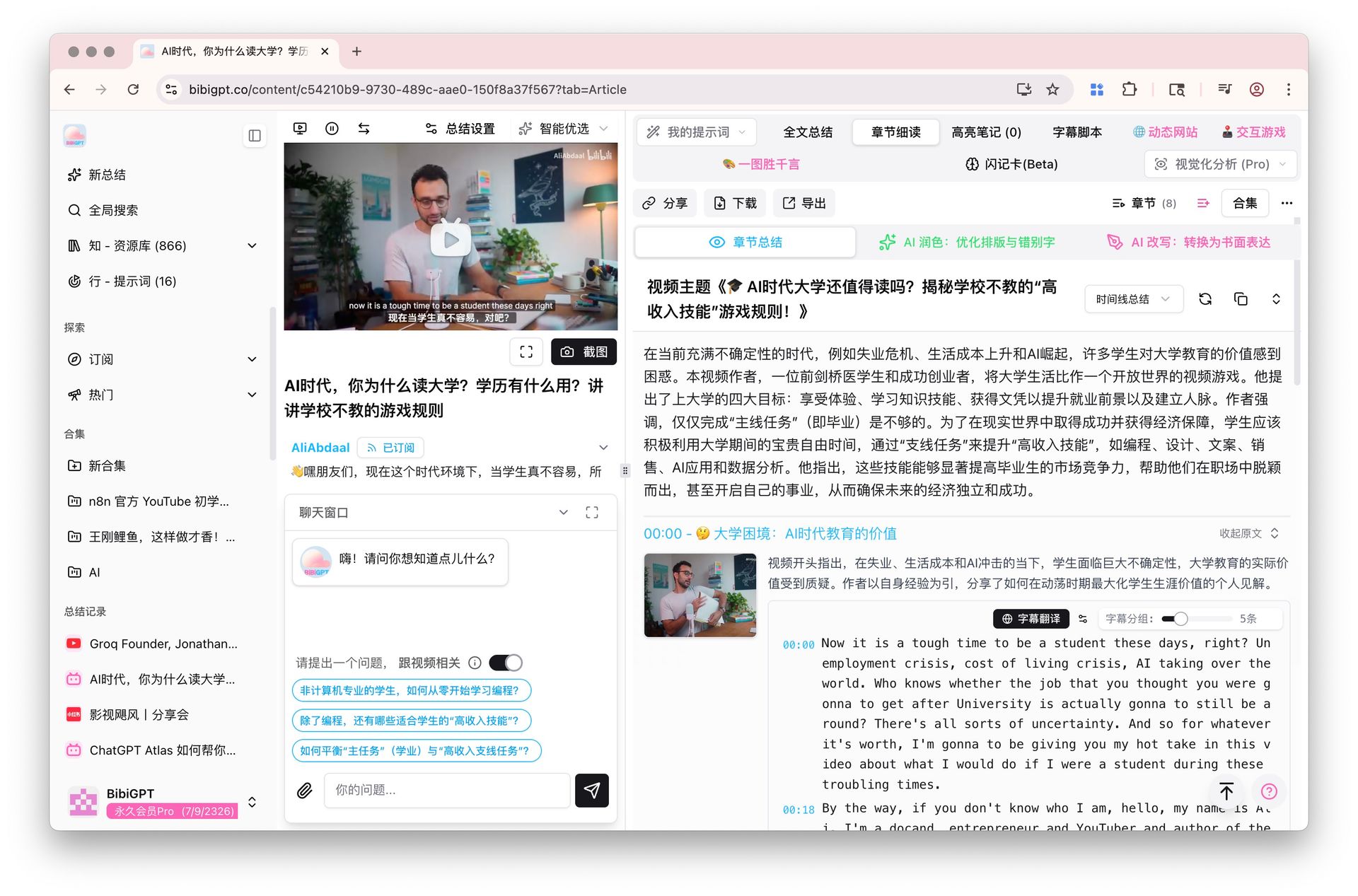
OpenAI GPT-Realtime-2 / Translate / Whisper Trio Deep Dive: Where Does BibiGPT Stand After the Realtime Voice Shock

Based on public info as of 2026-05-17: OpenAI rolled out three realtime voice APIs in mid-May — GPT-Realtime-2 (GPT-5 grade reasoning + realtime dialogue), GPT-Realtime-Translate (70+ input languages, 13 output), GPT-Realtime-Whisper (streaming transcription). For the first time, the voice-transcription, realtime-translation, podcast-summarization pipeline has a “cloud-native realtime” option that doesn’t require file upload.
100-word direct answer: OpenAI’s trio targets teams with in-house engineering bandwidth that need to integrate realtime voice via API If what you actually want is “paste a podcast/video link → get a timestamped summary, mind map, multilingual subtitles,” a one-stop workflow like BibiGPT is cheaper and more pragmatic. The breakdown below shows why.
What the Trio Actually Is: Clarify the Event First
OpenAI didn’t run a launch event for this. The three APIs went live via documentation updates and developer mailing list in mid-May 2026. According to VentureBeat’s coverage, the context is that Anthropic just overtook OpenAI in enterprise AI market share for the first time — and OpenAI is responding with “realtime voice + multimodality.”
Positioning of the three:
| API | Core Capability | Target Scenarios |
|---|---|---|
| GPT-Realtime-2 | GPT-5 grade reasoning + streaming voice dialogue | Realtime support, AI calls, two-way voice agents |
| GPT-Realtime-Translate | 70+ input languages → 13 output, realtime translation | Cross-border meetings, livestream interpretation, multilingual support |
| GPT-Realtime-Whisper | Streaming speech-to-text | Live captioning, realtime subtitles |
Practical rule: All three are “realtime streaming APIs.” You pipe audio over WebSocket and the server returns results chunk-by-chunk. They don’t replace the “upload a finished file, get an offline summary” path — which is exactly where BibiGPT and similar products live.
What This Means for BibiGPT Users: By Persona
Creators / Content Producers: Your Workflow Barely Changes
Your typical need: “Take a 1–3 hour podcast/interview link, give me a summary, timestamps, mind map, repurposable material.”
- OpenAI’s trio doesn’t directly cover the need — it handles “audio in progress,” whereas you work with “already-finished videos/podcasts.”
- What still fits your workflow is “paste link → pick model → get full set of artifacts.” BibiGPT YouTube summary, Bilibili summary, Podcast-to-article are all built for this.
The one thing that may shift: Livestream repurposing becomes more attractive — once OpenAI pushes “live audio → realtime captioning” cost down, turning livestreams into short-form content gets easier to do at scale.
Students / Researchers: Realtime Lecture Captions Get Cheap, But the Learning Loop Still Needs BibiGPT
One of the biggest beneficiaries of GPT-Realtime-Whisper streaming is “realtime captions in class.” But captions alone aren’t enough — you also need:
- Chapter-based navigation when reviewing
- Captions converted into searchable notes
- Anki-style spaced repetition
These are exactly what BibiGPT Chapter Deep Reading and Mind map export do.
Practical rule: trio is “raw-material grade API.” BibiGPT is “finished-product grade workflow.” Chaptering, prompt tuning, note formatting between raw and finished — that’s the part that actually eats study time.
Enterprises / Cross-border Teams: Cross-border Meetings Are the Real Win
Translate’s 70+ input / 13 output is genuinely impressive. Cross-border meetings, overseas product launches, multilingual support — these “in-progress” scenarios get “affordable simultaneous interpretation” for the first time.
But post-meeting: minutes, action items, archival search — those still need post-processing tools. A BibiGPT user can chain it like this:
- During the meeting: use OpenAI Translate for realtime captions
- The recording goes to BibiGPT Meeting Video-to-Document for structured minutes
- Minutes sync to Notion / Obsidian for action-item tracking
BibiGPT’s Differentiation Under Pressure: Not Another Model Aggregator
Practical rule: “Can call a Whisper API” and “let a user finish a 3h video in 3 seconds” are two completely different products. The former is an SDK; the latter is a workflow.
GPT-Realtime-AI transcription doesn’t replace BibiGPT, because BibiGPT was never solving “can we transcribe”:
- Link parsing for 30+ platforms: Bilibili, YouTube, TikTok, Xiaohongshu, Douyin, Apple Podcasts, Spotify, Substack video, enterprise Wistia, private Loom… paste-and-parse — no need to download audio and pipe it to an API yourself.
- Chapter segmentation + timestamp jumps: A 3-hour video doesn’t come back as a 500KB text blob. It’s split by topic, click-to-jump back to the original moment.
- Multi-model routing: The model selector hosts 30+ models — OpenAI, Claude, Gemini, DeepSeek, Qwen, etc. Not locked to any single vendor; you swap price/performance freely.
- Visual analysis + screen extraction: AI Visual Content Analysis pulls key frames, slides, on-screen text from the video — a raw Whisper API can’t do this.
- Workflows battle-tested at million-user scale: BibiGPT has served 1M+ users and generated 5M+ summaries. The detail polishing along the link-to-artifact pipeline has been hammered by real workloads, far beyond “wire up an API yourself.”
Practical Combo: How to Use OpenAI Trio + BibiGPT Together
If you genuinely want to combine realtime capabilities with BibiGPT’s finished workflow, here’s a recommended pattern.
Scenario: Cross-border Online Meeting + Post-meeting Archival
- During: GPT-Realtime-Translate for realtime captions across 70 input languages
- Recording: Sync record locally (Zoom / Google Meet)
- After: Paste recording URL into BibiGPT, pick Meeting Video-to-Document template
- Artifacts: Structured minutes with speaker segmentation, action items, timestamp anchors
- Export: Markdown to Notion / Mind map to Obsidian / EPUB for offline read
Scenario: Deep-learn an Overseas Podcast
- Sample: Paste link into BibiGPT, 30 seconds for bilingual summary to decide if it’s worth 1 hour of listening
- If yes: BibiGPT exports bilingual subtitles + chapter splits
- Review: Export from Subtitle translation into Anki for spaced repetition
Practical rule: trio is strong at “realtime.” BibiGPT is strong at “post-hoc structuring.” They don’t conflict — they compose into a more complete loop.
Forward Look: How Realtime Voice APIs Will Evolve
Based on OpenAI’s release cadence and H1 2026 market signals, three calls:
- Prices will keep dropping: Realtime voice is the front line between OpenAI, Google (Gemini Realtime), and Anthropic’s upcoming Claude Voice. Another price cut within the year is highly likely.
- “Realtime caption hardware” will become a new category: Earbuds, smart glasses, in-car will integrate Realtime APIs first. Limited impact on BibiGPT’s UX but a clear daily-meeting interpretation win.
- Offline + realtime will coexist long-term: Live, support, in-car go realtime; podcasts, education, enterprise archival stay in offline workflows — which is BibiGPT’s core territory.
FAQ: Common Follow-ups
Q1: Will BibiGPT integrate these three OpenAI models? BibiGPT’s multi-model routing is built for fast model integration. When GPT-Realtime delivers clear value for “post-upload summary” scenarios (e.g., transcription accuracy in a specific language), it will land in the model selector.
Q2: Can I skip BibiGPT and just wire up OpenAI APIs myself? You can — but you’ll have to solve: link parsing for 30+ platforms, chapter splitting algorithms, prompt tuning, UI, note-sync to external tools, multilingual routing. Those are years of BibiGPT engineering, not something “calling a AI transcription API” gets you.
Q3: Does realtime translation make BibiGPT’s subtitle translation obsolete? Different scenarios. Realtime translation handles “dialogue in progress.” BibiGPT’s subtitle translation handles “finished video” — which allows tighter terminology unification, speaker disambiguation, multi-pass refinement. Streaming APIs physically can’t do these.
Q4: After streaming Whisper, does BibiGPT’s transcription still have an edge? Yes. BibiGPT’s transcription is not a single model — it’s “multiple transcription engines + post-processing correction + chapter segmentation” as a composite pipeline. The API gives you raw text; BibiGPT gives you structured output.
Q5: When should I use OpenAI directly and skip BibiGPT? You’re building: realtime two-way dialogue agents, livestream simultaneous interpretation, voice support bots — those “realtime streaming” scenarios use OpenAI directly “Post-hoc structuring” scenarios use BibiGPT.
Try BibiGPT’s One-stop Audiovisual Workflow
Models are no longer scarce. The speed at which you consume content is what’s scarce now. BibiGPT compresses the link-to-artifact pipeline into a 30-second response so you can spend the saved hours on what actually matters.
Try it: bibigpt.co
—— BibiGPT Team
Popular tools
More in this series
- Apple iOS 27 Opens Third-Party AI: The Era of Switchable Assistants Is Here — How to Choose for Audio and Video (2026)
- DeepSeek R1 + BibiGPT: A Practical Guide to AI-Powered Audio/Video Understanding in 2025
- DeepSeek-V4 đã đến! BibiGPT ra mắt bốn mô hình mới + 1M context ngay ngày đầu — Tóm tắt video & podcast bằng AI vừa lên cấp
- BibiGPT vs DeepSeek-V4 + Granite Speech Plus 2026: Self-Hosted Open Source vs Productized Stack
- Claude Opus 4.6 Agent Teams Are Here: How AI Agents Are Transforming Video Understanding with BibiGPT