BibiGPT vs DeepSeek-V4 + Granite Speech Plus 2026: Self-Hosted Open Source vs Productized Stack

Compiled May 16, 2026. Sources: HuggingFace v5.8.0 release notes and each model’s official docs.
In May 2026 HuggingFace transformers v5.8.0 shipped two open-source models that matter for BibiGPT users: DeepSeek-V4 (MoE, Flash/Pro/Base tiers) and IBM Granite Speech Plus (multimodal STT + speaker diarization + word-level timestamps). The open-source crowd lit up: “I’ll just self-host. No SaaS needed.” Really? Let’s run the actual numbers.
Practical rule: A stronger open-source model doesn’t make “self-host” automatically cheaper. The right number to compute is total cost of ownership — not the “free” stamp on the model card.
BibiGPT has served over 1 million users and generated 5 million+ AI summaries across the past three years. Under the hood we use models like DeepSeek and Granite — but we wrap model selection, routing, billing, ops, and product experience into a single surface. This comparison evaluates “self-host” vs “BibiGPT” from the user’s perspective.
1. What’s Actually Different
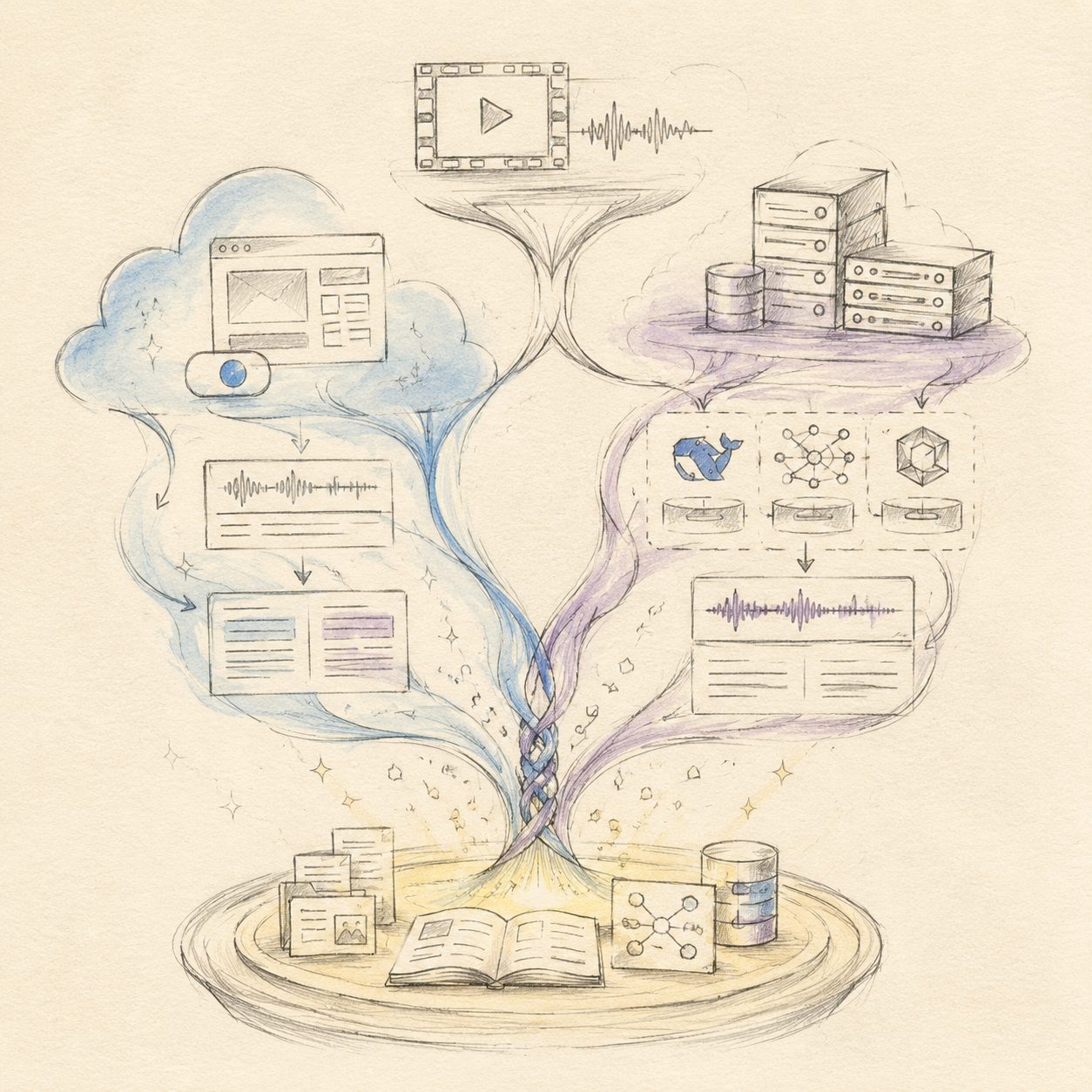
Path A: Self-host DeepSeek-V4 + Granite Speech Plus
Pull weights from HuggingFace; run them on your own GPU box or cloud rental.
- DeepSeek-V4 Pro: ~130B params (MoE, ~22B active); needs 2× A100 per inference
- Granite Speech Plus: ~8B params; one T4 is enough
Path B: BibiGPT productized
Open bibigpt.co, paste URL, get result.
| Path A (self-host) | Path B (BibiGPT) | |
|---|---|---|
| Time to first result | 1–2 weeks setup | 30 seconds paste |
| Monthly fixed cost | $400–1500 GPU rental | $0–30 subscription |
| Ops burden | You, 24/7 | BibiGPT team |
| Model upgrades | Track yourself | Auto, server-side |
| Cross-platform | Build your own scraper | 30+ native |
Practical rule: Open-source model cost isn’t “the model.” It’s “ops + GPU + your engineering time.” The first two are quantifiable; the third is consistently underestimated.
2. How DeepSeek-V4 Fits Into the BibiGPT Workflow

DeepSeek-V4’s core strengths are Chinese reasoning and long context. Per HuggingFace transformers v5.8.0 release notes, V4 Pro improves Chinese reasoning benchmarks by ~18% over V3.
BibiGPT’s multi-model routing wired DeepSeek-V4 into the backend pool in April 2026. Which means BibiGPT users are already on V4 — they just don’t need to know which model the request hit.
If you’re a developer: DeepSeek-V4’s open-source license allows commercial self-hosting. But you need:
- 2× A100 (80GB) GPUs, roughly $1000/mo in cloud
- vLLM or TGI inference framework
- Prompt engineering, context management, rate-limit logic — all written by you
If you’re an end user: Just use BibiGPT. The backend routes by content type (Chinese long video / English podcast / multilingual subtitles) — DeepSeek-V4 might be the answer, or Claude, Gemini, GPT.
3. How Granite Speech Plus Fits In
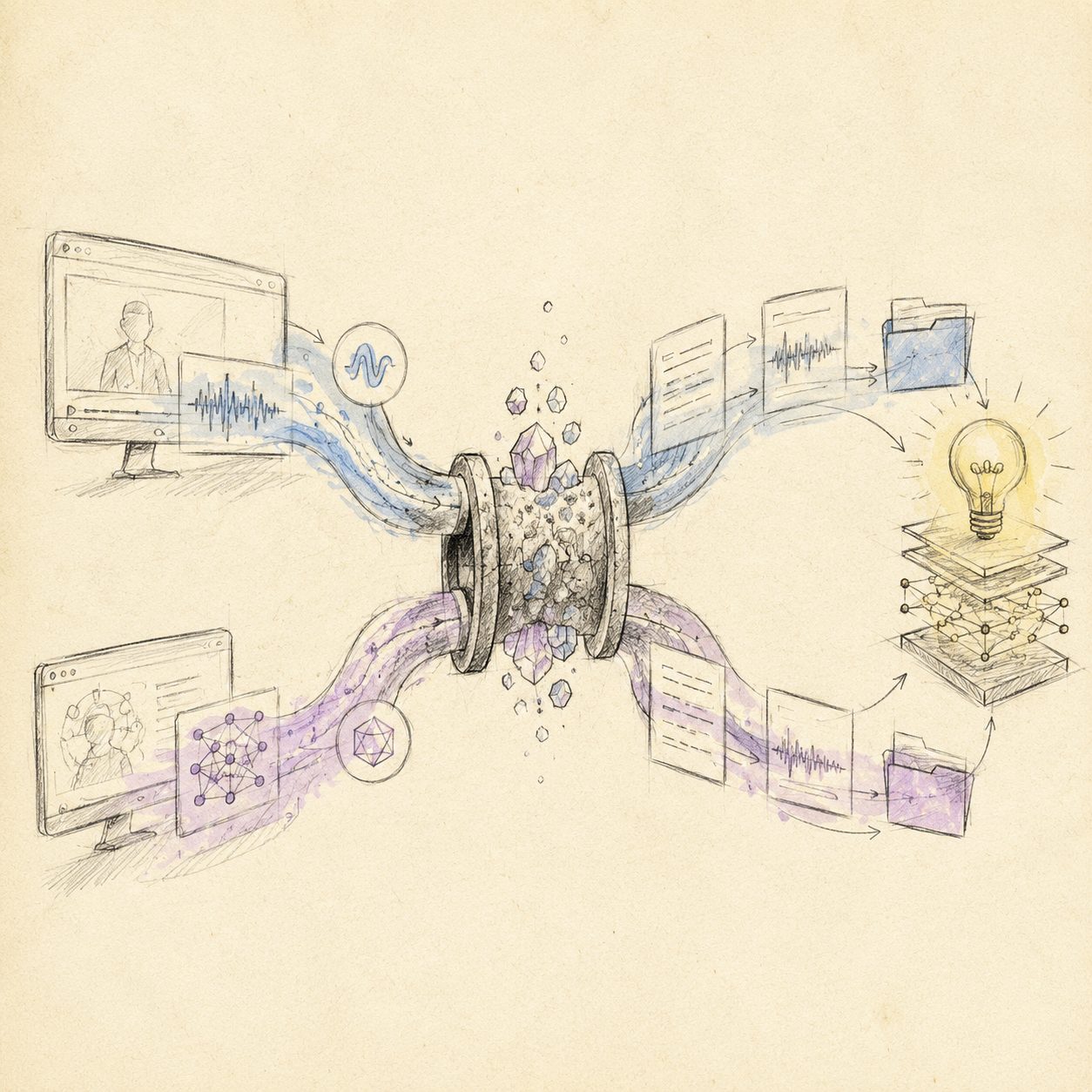
Granite Speech Plus’s strengths are speaker diarization and word-level timestamps — useful for meeting recordings, interviews, podcasts.
Per IBM’s announcement, Granite Speech Plus hits ~4.1% WER on LibriSpeech test-other — production-ready.
If you’re a developer: Granite Speech Plus is smaller and faster than Whisper. One T4 can handle multiple concurrent audio streams.
If you’re an end user: BibiGPT’s meeting recording transcription already runs at this tier. Upload a 60-minute recording, get back a speaker-tagged transcript with chapter summaries in 3 minutes. No GPU.
YouTube demo of BibiGPT processing a meeting recording end-to-end:
https://www.youtube.com/embed/SbgNX3sMSXQ
4. Real-World Cost Comparison

Three real scenarios with the numbers:
Scenario 1: Individual user, 30 hours of content per month
- Self-host: GPU rental $400 (cheapest T4) + your 20 hours of setup/maintenance ≈ $400 + time cost
- BibiGPT Plus: $10/mo, zero time cost
Verdict: Unless your GPU is already running for something else, self-hosting doesn’t pencil out.
Scenario 2: Content team, 200 hours/month
- Self-host: 2× A100 ≈ $1500/mo + 50% of one engineer’s time ≈ $4000/mo
- BibiGPT Pro + team seats: $80/mo
Verdict: BibiGPT is 50× cheaper.
Scenario 3: Enterprise batch, 2000 hours/month
- Self-host: 4× A100 + dedicated DevOps ≈ $10000/mo
- BibiGPT API access: ~$0.05/min × 120000 = $6000/mo
Verdict: BibiGPT still ~40% cheaper, with zero ops overhead.
Practical rule: When pricing GPU cloud, add “maintenance hours × hourly wage.” A $30/hr engineer doing 50 hours of upkeep = $1500 hidden cost. Most teams forget this line.
| Scenario | Self-host $/mo | BibiGPT $/mo | Multiple |
|---|---|---|---|
| Individual 30h | $400+ | $10 | 40× |
| Team 200h | $4000 | $80 | 50× |
| Enterprise 2000h | $10000 | $6000 | 1.7× |
5. When Self-Hosting Still Makes Sense
Three scenarios where self-hosting open-source is still right:
Case 1: Extreme data compliance
Classified meetings, legal recordings, medical interviews — data can’t leave the premises. Self-host on internal servers is the only option.
Case 2: You already run a GPU cluster
If your team has an idle A100 cluster (for AI training), marginal cost of deploying is near zero.
Case 3: You need fine-tuning
If you’ll LoRA / fine-tune DeepSeek-V4 on your domain data, you must self-host. BibiGPT uses general models; we don’t do per-customer custom training.
Practical rule: Self-hosting should be driven by hard constraints, not by the psychological pull of the word “free.”
6. Frequently Asked Questions
Q1: Does BibiGPT use DeepSeek-V4?
BibiGPT’s multi-model routing picks dynamically by content, language, and budget. DeepSeek-V4 is heavily used for Chinese long-context jobs, but it’s not the only model.
Q2: Can I force BibiGPT to use Granite Speech Plus?
End users don’t expose model selection — this is by design. Most users don’t need or want to care. Enterprise API customers can negotiate custom routing with sales.
Q3: How hard is it to self-host DeepSeek-V4?
Not hard, but requires ML engineering experience. HuggingFace transformers v5.8.0 + vLLM is the mainstream stack. Budget 1–2 weeks for setup.
Q4: How much better is Granite Speech Plus vs Whisper?
Per IBM benchmarks, Granite Speech Plus is ~1.5% more accurate than Whisper Large v3 on English LibriSpeech and ~2.3× faster. Chinese results are roughly equivalent.
Q5: Will BibiGPT get disrupted as open-source matures?
The opposite. The stronger and more numerous models become, the more complex routing decisions get — and the more value an abstraction layer like BibiGPT delivers. Open-source Linux didn’t kill server vendors; it pushed them up the stack.
Q6: Can DeepSeek-V4 output sync directly to Notion?
No. A model produces text. Going from text to Notion requires formatting, API integration, error handling — that’s exactly what BibiGPT’s Notion / Obsidian sync does for you.
Q7: Will OpenAI or Google acquire or replace BibiGPT?
Our lane is content consumption workflow — not competing with model providers. won’t build crawlers for 30+ Chinese platforms. Google won’t ship a Xiaohongshu podcast sync. Product layer vs model layer.
7. Take This Comparison Home
If you deal with audio/video content for learning, creation, or work — run 30 days on BibiGPT before considering self-hosting. Open bibigpt.co and paste a link.
Further reading: GPT-Realtime-2 vs BibiGPT Real-time Translation 2026 · Best AI Real-time Translation Tools 2026
— BibiGPT Team
Popular tools
More in this series
- Apple iOS 27 Opens Third-Party AI: The Era of Switchable Assistants Is Here — How to Choose for Audio and Video (2026)
- DeepSeek R1 + BibiGPT: A Practical Guide to AI-Powered Audio/Video Understanding in 2025
- DeepSeek-V4 đã đến! BibiGPT ra mắt bốn mô hình mới + 1M context ngay ngày đầu — Tóm tắt video & podcast bằng AI vừa lên cấp
- Claude Opus 4.6 Agent Teams Are Here: How AI Agents Are Transforming Video Understanding with BibiGPT
- Claude Opus 4.7 Fast Mode vs BibiGPT 2026: Which Is Worth Using for Long Video Streaming Summary