SQ3R Reading Method x AI Video Learning: A 5-Step Workflow to Actually Learn from Videos and Podcasts (BibiGPT, 2026)
SQ3R Reading Method x AI Video Learning: A 5-Step Workflow to Actually Learn from Videos and Podcasts (BibiGPT, 2026)
80-word direct answer (as of 2026-05-09): SQ3R is a classic 1946 active reading method with 5 steps — Survey / Question / Read / Recite / Review. Porting it from paper reading to AI video and podcast learning maps cleanly onto BibiGPT’s chapter summary preview, AI conversation Q&A, mind-map-driven deep reading, note export for recitation, and history-based spaced review. This combination upgrades you from passive watcher to active learner.
Why most people “watch videos but learn nothing”
I’ve run informal experiments where a group watches the same 1-hour podcast, then 24 hours later I ask them to recap the core argument. About 80% can only repeat 2-3 scattered punchlines — almost no one can reproduce the full chain of reasoning.
This isn’t a memory problem. It’s that watching video is inherently passive: audio and visuals march by at constant speed, your attention skims the surface, and most content slides off without sticking.
Reading at least gives you one advantage: you can slow down, reread, and annotate. Video doesn’t allow that.
The essence of SQ3R is converting “passive reception” into “active inquiry.” Proposed in 1946 by psychologist Francis Robinson, the method has held up for 80 years. In the AI tooling era it’s actually more useful than in print — because video is no longer an unpausable, unannotatable black box.
SQ3R x BibiGPT capability mapping
| SQ3R Step | Core action | How to do it in BibiGPT |
|---|---|---|
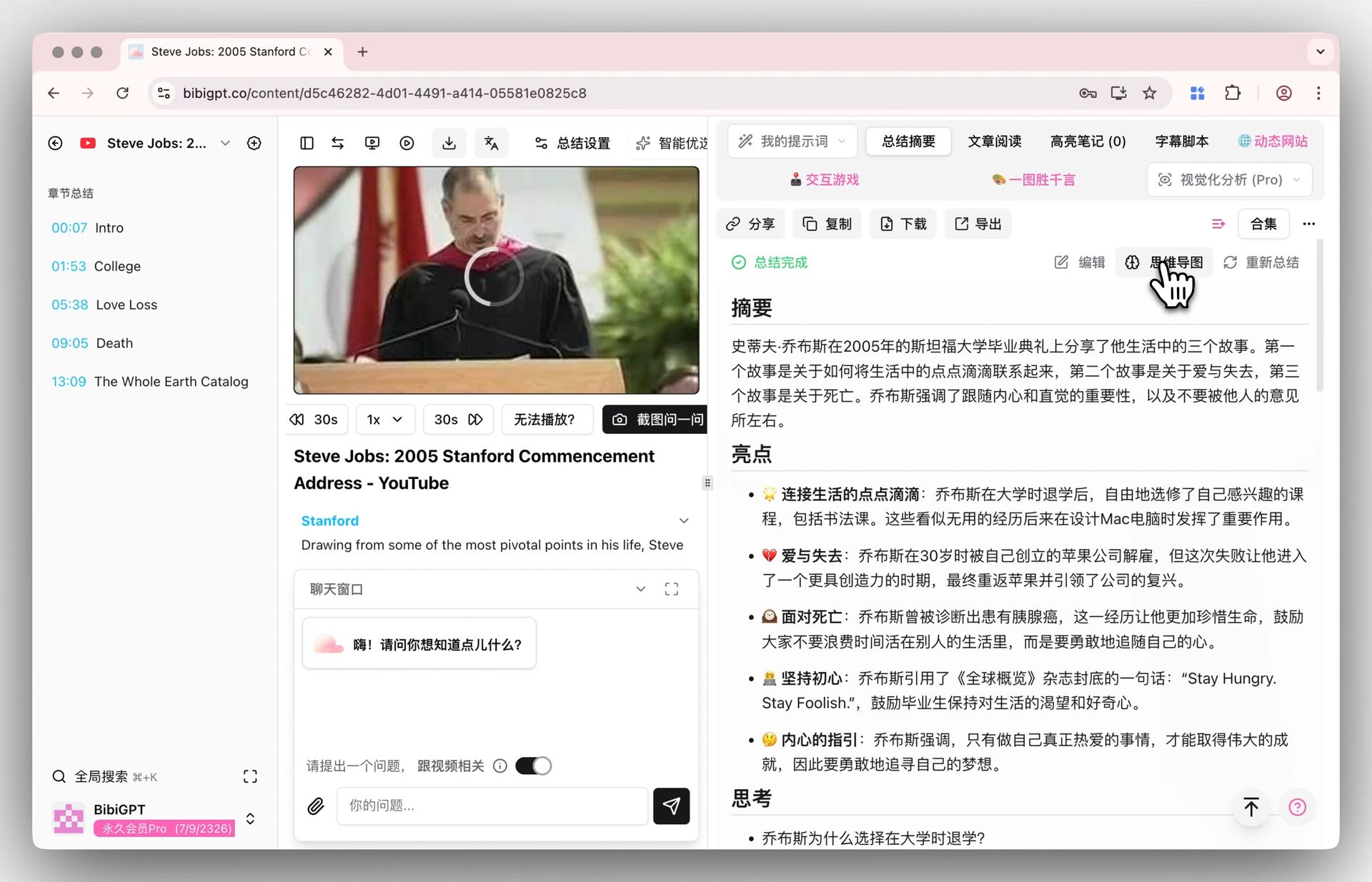
| Survey | Skim the whole, build a frame | Read BibiGPT’s auto-generated chapter summary + mind map |
| Question | Turn each chapter title into a question | Use AI chat to ask “why / how” for each chapter |
| Read | Read deeply with questions in mind | Use mind map nodes + clickable timestamps to jump back to relevant video segments |
| Recite | Restate in your own words | Export Markdown notes to Notion / Obsidian, add your own annotations |
| Review | Revisit a day / week / month later | BibiGPT history + linked notes for spaced repetition |
Now let’s break down each step with concrete moves.
Step 1: Survey — sketch the skeleton first
Goal: Before you commit to watching the full hour-long video, spend 30 seconds building a “map.”
Traditional reading
Open the book, scan the table of contents, chapter titles, intros, and conclusions — this takes 5-10 minutes and gives you a rough mental map of the whole book.
BibiGPT version
Go to bibigpt.co, paste the video link, wait 30 seconds to 2 minutes. BibiGPT auto-generates:
- Chapter summary: a 1-hour video sliced into 5-8 chapters, each with a heading + bullet points.
- Mind map: hierarchical structure showing the skeleton.
Key move: Spend 1-2 minutes scanning chapter titles and the mind map only. Don’t drill into any specific chapter for details yet. This step is about establishing the global map so the next steps have anchor points.
Step 2: Question — turn statements into questions
Goal: Convert each chapter title into a concrete question — this is the most critical step in SQ3R.
Traditional reading
Seeing a chapter titled “Brain Plasticity” — turn it into “What are the specific manifestations of brain plasticity? At what age does plasticity decline?”
BibiGPT version
Open the AI conversation chat window (right side of the video detail page). Actively probe each chapter title:
Example 1: Chapter titled “AI training costs”
→ “What’s the concrete cost of training a GPT-5-class model? What are the main line items?” → “How has this cost evolved from the GPT-4 era? Why?”
Example 2: Chapter titled “Startup positioning”
→ “Does the speaker argue startups should pick vertical or horizontal markets? Why?” → “Which counter-examples did they cite? What were the failure modes?”
Why this step is critical: Once you’ve asked questions, your attention shifts from “what” to “why” and “how” — comprehension goes one level deeper. Reading with a question vs reading without — the absorption difference is 3-5x.
Step 3: Read — go deep with questions in hand
Goal: Now that you have specific questions, return to the video content to find answers.
Traditional reading
Read the relevant chapter with the question in mind, highlight, annotate.
BibiGPT version
Three deep-reading paths, choose by scenario:
Path A: Jump from mind map node directly back to video segment
Every mind map node has a timestamp. With a question like “why does the speaker think RAG is more worth pursuing than fine-tuning for startup teams?” — find the relevant node, click to jump to the original 2-minute segment, watch only those 2 minutes.
Path B: Probe details via AI chat
Don’t want to jump back to the video? Ask in AI chat directly: “what concrete evidence does the speaker provide for the RAG vs fine-tune argument around minute 14?” The AI answers based on video content with timestamp citations.
Path C: Export the transcript and read it like a paper
For dense theoretical content, export the full transcript (BibiGPT supports SRT / Markdown export), open it in your text editor, read it like an academic paper.
Key technique: Step 3 isn’t about watching the full video at 1x speed. You’re using the question list from Step 2 to selectively consume the video — you may only deeply engage with 30%, but that 30% is what actually sticks.
Step 4: Recite — restate in your own words
Goal: Close the book and recite what you just learned in your own words. This is the step in SQ3R that contributes most to long-term memory.
Traditional reading
Close the book, face a blank page or just your mind, and tell the chapter’s argument back to yourself in your own words. If you can articulate it, you understand it. If you can’t, you didn’t.
BibiGPT version
BibiGPT supports exporting summaries and notes to Markdown, flowing into your own notes system:
- To Notion: copy-paste Markdown / Notion API integration.
- To Obsidian: save directly as
.mdfiles in your vault. - To Lark / SiYuan: via notes integration.
Key action: In your notes, add a “My recitation” section. Use BibiGPT’s chapter summary as reference, but in your own words, retell the entire argument from start to finish.
While reciting, check yourself with three questions:
- What’s the speaker’s core thesis? (one sentence)
- How do they support that thesis? (3-5 supporting points)
- Do you agree? Why? (this turns external knowledge into your own opinion)
Pair with BibiGPT’s AI video-to-article: let AI generate a structured article skeleton first, then layer your “recitation” on top — 5x faster than writing from scratch.
Step 5: Review — revisit after a day / week / month
Goal: Convert one-time learning into long-term memory. Spaced repetition is one of the most validated mechanisms in cognitive science.
Traditional reading
A week after closing the book, reopen your notes plus the original key passages.
BibiGPT version
BibiGPT keeps a complete history:
- Day 1+1: Return to BibiGPT history, read only your notes, not the video — recalling 70% counts as success.
- Week 1+1: Run the “recitation triple-check” again — full answers mean it’s locked in.
- Month 1+1: Filter the past month’s content from BibiGPT history and merge by theme — turn scattered video notes into a “topic map.”
Advanced play: Use AI highlight notes to mark and annotate key segments, jump straight to highlights during review — no need to re-skim from the top.
SQ3R x BibiGPT case: learning a 1-hour finance podcast
Say you found a 1-hour Acquired podcast on NVIDIA’s history. Run the SQ3R x BibiGPT flow:
| Time | Step | Action |
|---|---|---|
| 0-2 min | Survey | Paste link to BibiGPT, wait for chapter summary + mind map, scan |
| 2-7 min | Question | Turn 6 chapter titles into 1-2 questions each, list at top of notes |
| 7-25 min | Read | Use AI chat + mind map jumps to answer the question list |
| 25-40 min | Recite | Write a 500-word “my recitation” in Notion / Obsidian, add agree/disagree notes |
| Next day | Review | Return to notes, read only your recitation, recalling 70% = locked in |
Total investment: 40 minutes + 5 min the next day = 45 minutes.
Compared to passively watching 1 hour: you spent 15 minutes less, but comprehension depth and long-term retention are at least 3x higher — because you actively thought, asked, and recited.
FAQ
Q1: Isn’t 5 steps too much work? I just want to watch videos casually.
A: You can run only the first 2 steps (Survey + Question) and the last (Review). You can drop the middle, but never the bookends — without Survey you’re reading blind, without Review you’ll forget everything.
Q2: Does SQ3R fit every video?
A: No. SQ3R fits theory-heavy, argumentative content (academic talks, deep interviews, industry analysis, knowledge explainers). Light entertainment (comedy, life vlogs) doesn’t need SQ3R — just enjoy.
Q3: What other tools pair well with SQ3R besides BibiGPT?
A: The core stack is BibiGPT (video structuring) + Notion / Obsidian (notes) + Anki / RemNote (spaced repetition flashcards). Three tools cover the full learning loop.
Q4: I watch English podcasts but my listening is weak. Can SQ3R still work?
A: Yes. BibiGPT’s auto-translate on upload generates bilingual subtitles directly — listening barriers removed, you can focus on the SQ3R loop itself.
Q5: 45 minutes per video is a lot. I watch 3 videos a day.
A: Then run full SQ3R only on your most important video, and run a “lite version” on the other 2 — Survey + Recite only (read summary + write one sentence). One deep dive + five lite passes a week beats “passively watching 3 videos a day and remembering nothing” by 10x.
Q6: How does SQ3R relate to the Feynman technique and active recall?
A: They complement. SQ3R gives you a “step framework for learning a single piece of content”; Feynman gives you a “specific method for the recitation phase (explain to a 5-year-old)”; active recall is the core action of the Review phase (close notes, reconstruct from memory). Use all three together for best results.
Q7: Is BibiGPT fully free?
A: BibiGPT offers free quota for everyday use; heavy users, Pro transcription engine, and batch processing benefit from Plus or higher tiers. See bibigpt.co/pricing.
Summary: from “watched it” to “learned it”
Passive video watching is a 2010s habit. In the AI tooling era, the cost of active learning has dropped to its lowest ever — BibiGPT handles “structuring, questioning, jumping, exporting” engineering complexity, leaving you to focus on “thinking, asking, reciting, reviewing.”
SQ3R, an 80-year-old method, has finally found its best medium in 2026. Next time you want to seriously learn from a video, try these 5 steps — you’ll feel firsthand that “watching a 1-hour video” and “learning from a 1-hour video” are two completely different things.
Try the BibiGPT + SQ3R workflow: bibigpt.co. Further reading: YouTube to mind map AI tools complete guide | Zettelkasten method x AI video notes