AI Haoji vs BibiGPT 2026 Full Comparison: Use Case, Platform Coverage, Multilingual, Mind Map Depth, Pricing — Which Should You Pick?
AI Haoji vs BibiGPT 2026 Full Comparison: Use Case, Platform Coverage, Multilingual, Mind Map Depth, Pricing — Which Should You Pick?
80-word direct answer (as of 2026-05-09): AI Haoji and BibiGPT are both leading Chinese AI audio/video transcription and summarization tools, but they’re positioned differently — AI Haoji excels at “long video to article-style notes + per-second frame extraction,” ideal for WeChat-style image articles and academic organization; BibiGPT excels at “30+ platform native integration + mind map depth + AI conversation Q&A + multi-device coverage (Web / Desktop / Browser Extension / Mobile),” ideal for content creators, cross-platform learners, knowledge workers. Features overlap, but the focus differs — picking the wrong one wastes value.
1. Why so many people debate AI Haoji vs BibiGPT
Tools that “paste a link → auto-transcribe → AI summary” in the Chinese market are limited — only a handful of major players. AI Haoji and BibiGPT often get compared in public reviews and user forums, but the two tools have completely different product philosophies:
- AI Haoji (built by Hefei Zhilan Yuejing Technology): positioned as “AI video note tool,” focused on audio/video to article-style notes + per-second timestamp frame extraction — that’s its core differentiator. Integrates DeepSeek model, outputs article notes, podcast-style dialogues, AI summaries, mind maps.
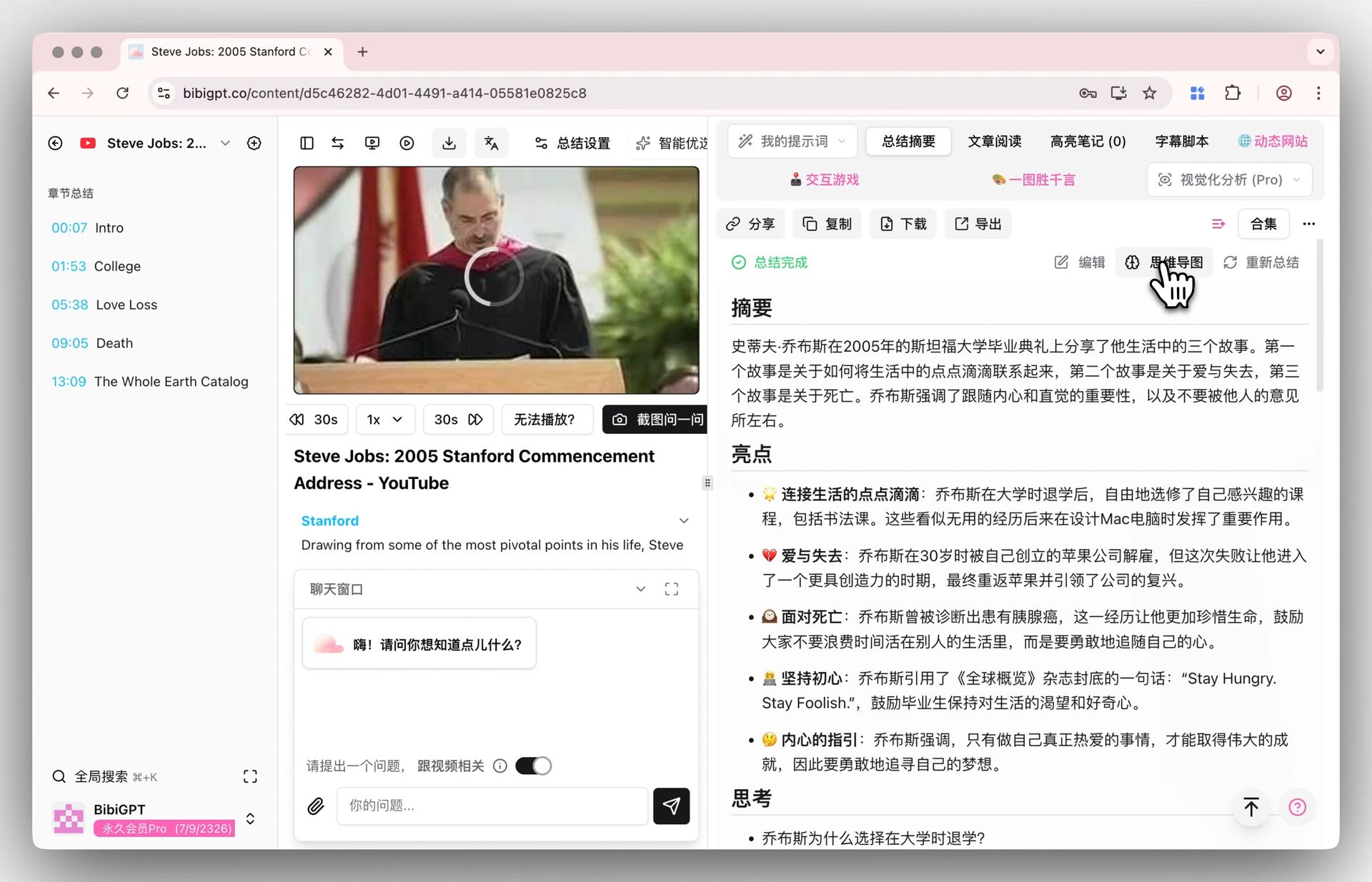
- BibiGPT: positioned as “AI audio/video assistant + Knowledge-Action assistant,” focused on 30+ platform native integration + mind map depth + multi-device (Web / Desktop / Chrome/Firefox/Edge extension / Android / iOS) + Agent Native tooling (giving AI Agents the ability to watch videos).
Simply: AI Haoji squeezes the most out of a single video; BibiGPT covers the full chain across platforms and scenarios.
2. 5 core dimension comparison
1. Use case positioning
| Tool | Position | Best fit |
|---|---|---|
| AI Haoji | AI video notes + image article conversion | Long video → WeChat image article, academic organization, video frame extraction, teachers / students |
| BibiGPT | AI audio/video assistant (consume existing content) | Cross-platform learners, content creators, knowledge workers, enterprise API users, Agent integration |
Key difference: AI Haoji’s image notes + frame extraction is friendly to “watch video → write article” content creators; BibiGPT’s multi-device + Agent integration is friendly to those who treat video learning as a daily workflow.
2. Platform coverage
| Tool | Online link platforms | Local upload |
|---|---|---|
| AI Haoji | Major platforms (YouTube, Bilibili, Douyin, etc.) + file upload | ✅ |
| BibiGPT | YouTube + Bilibili + Douyin + TikTok + Xiaohongshu + Spotify + Apple Podcasts + 30+ platforms native | ✅ + browser extension + desktop client drag-and-drop |
Key difference: BibiGPT’s 30+ platform native integration is one of its core moats — for users who simultaneously use YouTube + podcasts + Bilibili + Xiaohongshu, one BibiGPT account covers all sources. AI Haoji also supports major platforms and uploads, but BibiGPT goes deeper and broader on the platform list.
3. Multilingual capability
| Tool | Transcription languages | Summary output languages | Subtitle translation |
|---|---|---|---|
| AI Haoji | Multilingual | Translate to dozens of languages | ✅ Built-in translation |
| BibiGPT | Multilingual + ElevenLabs Scribe option | Native zh/en/ja/ko/zh-TW | ✅ + auto-translate on upload + bilingual subtitle sync |
Key difference: BibiGPT’s multilingual goes deeper — “upload once, get bilingual subtitles in a single pass” is a real engineering win for cross-language short-form creators and cross-language podcast learners. AI Haoji’s translation is also good, but more focused on “summary translation” — its handling of “synchronized bilingual subtitles” is less robust.
4. Mind map depth
| Tool | Mind map capability | Node jump | Export |
|---|---|---|---|
| AI Haoji | ✅ Generate mind map (from summary) | ⚠️ Partial | Multiple formats |
| BibiGPT | ✅ Auto 3-5 levels + chapter summary linkage | ✅ Nodes jump directly to video timestamps | Markdown / OPML / Notion / Obsidian |
Key difference: BibiGPT’s mind map nodes carry timestamps and jump directly back to original video segments — critical for “secondary learning / deep reading” scenarios. AI Haoji’s mind map is more “visualization of a summary,” BibiGPT’s is more “interactive entry point to video content.”
5. Pricing + free tier
| Tool | Free tier | Paid tiers | Pricing |
|---|---|---|---|
| AI Haoji | New user: 90 minutes parsing time | Pay-per-use + monthly/yearly | Per official site (priced by parsing minutes) |
| BibiGPT | Daily free quota + free browser extension | Plus / Pro subscription + pay-as-you-go | Plus from $19.8/mo |
Key difference: AI Haoji follows “pay by parsing duration” logic — controllable for heavy users but you have to count minutes. BibiGPT runs dual-track “subscription + pay-as-you-go” — regular users go subscription, enterprise / API users go pay-as-you-go, two pricing models in parallel. See bibigpt.co/pricing.
3. 6-dimension overview matrix
| Dimension | AI Haoji | BibiGPT | Winner |
|---|---|---|---|
| Transcription accuracy (Chinese) | ★★★★ | ★★★★★ (with optional ElevenLabs Scribe) | BibiGPT |
| Platform native support | ★★★★ | ★★★★★ (30+ platforms) | BibiGPT |
| Mind map depth | ★★★★ (generative) | ★★★★★ (with timestamp jump) | BibiGPT |
| Video frame extraction | ★★★★★ (per-second extraction) | ★★★ (visual analysis) | AI Haoji |
| Image-article conversion | ★★★★★ (long video → image article) | ★★★★ (AI video-to-article) | Slight edge AI Haoji |
| AI conversation Q&A | ★★★ | ★★★★★ (AI chat) | BibiGPT |
| Multi-device coverage | Web-primary, weak elsewhere | Web + Desktop + Chrome/Firefox/Edge extension + Android/iOS | BibiGPT |
| Agent integration | ❌ | ✅ (BibiGPT Agent Skill, gives Agents video viewing) | BibiGPT |
| Multilingual depth | ★★★★ (translate summary) | ★★★★★ (sync bilingual subtitles) | BibiGPT |
| Free tier | New user one-time 90 min | Daily fixed free quota | Slight edge BibiGPT (continuous) |
4. Choose by scenario
Scenario 1: Video blogger turning a 1-hour video into a 3000-word article + images
→ AI Haoji. Its per-second timestamp frame extraction can auto-pull key visuals as illustrations, saving manual screenshot work. BibiGPT’s AI video-to-article can do this too but extraction granularity is less fine.
Scenario 2: Cross-platform learner watching 10 hours/week across YouTube + podcasts + Bilibili + Xiaohongshu
→ BibiGPT. 30+ platform native integration, one tool for all sources; mind map with timestamp jumps for deep reading; browser extension lets you “summarize directly on YouTube/Bilibili page” without switching tools. Try bibigpt.co.
Scenario 3: Teacher organizing 3 hours of lecture audio into image-rich teaching materials
→ Either works. AI Haoji’s image notes directly produce “image + text + timestamp” lesson template; BibiGPT’s chapter summary + mind map fits topic-based synthesis. Distinguishing factor: is the downstream “publish with images” (→ AI Haoji) or “structured into knowledge system” (→ BibiGPT)?
Scenario 4: Cross-language learner watching English open courses / Japanese podcasts for study notes
→ BibiGPT. Auto-translate on upload + sync bilingual subtitles is BibiGPT’s engineering edge; native Chinese / English / Japanese / Korean / Traditional Chinese output.
Scenario 5: Enterprise / API user batch-processing 100+ hours of customer interviews
→ BibiGPT. Provides API + pay-as-you-go pricing + Agent Native tooling (BibiGPT Skill lets AI Agents call BibiGPT to view videos directly). AI Haoji’s API capabilities are weaker.
Scenario 6: Developer wanting their AI Agent to “watch videos”
→ BibiGPT. BibiGPT Skill is one of China’s first Agent Native video tools, giving Claude Code, Cursor, and similar AI Agents the ability to watch videos. AI Haoji doesn’t currently offer this.
5. User switching decision checklist
If you currently use AI Haoji, consider switching to BibiGPT in these scenarios:
- Your content spans YouTube + podcasts + Bilibili + Xiaohongshu and you need one tool for all sources
- You need bilingual subtitles and cross-language learning for English / Japanese / Korean podcasts
- You want mind map nodes to jump back to specific video segments for deep reading
- You’re a developer / Agent user needing BibiGPT Skill / API capabilities
- You need desktop client / browser extension / mobile app multi-device sync
If you currently use BibiGPT, AI Haoji can complement you in these scenarios:
- You produce “long video → WeChat image article” content needing per-second video frame extraction
- Your core scenario is “upload file → image notes,” with no need for multi-platform coverage
- Your budget logic is “pay once for parsing minutes” not subscription
Many creators use both — AI Haoji handles “image asset production,” BibiGPT handles “daily learning + cross-platform consumption.”
6. 6 common decision questions
Q1: Whose transcription accuracy is higher?
A: Both work well in mainstream scenarios. BibiGPT’s custom transcription engine lets pro users switch to ElevenLabs Scribe with BYOK — friendlier for max-precision use cases.
Q2: Whose mind map is better?
A: BibiGPT’s mind map nodes carry clickable timestamps and jump directly to video — deeper. AI Haoji’s mind map is more “visualization of a summary.”
Q3: Whose free tier is more cost-effective?
A: AI Haoji is “new user one-time 90 minutes.” BibiGPT is “daily free quota available.” Long-term, BibiGPT’s accumulated quota adds up to more; for one-off short-term use, AI Haoji’s 90 minutes might be enough.
Q4: Can I export to Notion / Obsidian?
A: BibiGPT natively supports Markdown export (works with Notion / Obsidian), plus direct integrations for Lark / SiYuan. AI Haoji also supports multiple export formats (Word / PDF / Markdown / HTML), but its integration depth with Notion / Obsidian is not as deep as BibiGPT’s.
Q5: Which fits enterprise batch processing?
A: BibiGPT. API + pay-as-you-go pricing make enterprise batch use cases more mature. AI Haoji is mainly C-end focused.
Q6: Which is for developers?
A: BibiGPT. Its BibiGPT Agent Skill lets Claude Code, Cursor, and similar AI Agents directly call its video-viewing capability — important infrastructure for the Agent Native era.
7. Conclusion: which should you pick?
Quick decision:
- Content creator + mainly “video → WeChat image article” + emphasis on video frame extraction → AI Haoji
- Cross-platform learner + knowledge worker + content creator + cross-language + multi-device sync → BibiGPT
- Enterprise API user / developer / Agent integration → BibiGPT
Most practical advice: try both.
Try BibiGPT now: bibigpt.co. Paste a recent video/podcast link, see chapter summary + mind map + AI Q&A in 30 seconds, then compare with AI Haoji’s image-note experience — 5 minutes hands-on beats 100 reviews.
Try BibiGPT: bibigpt.co. Further reading: YouTube to mind map AI tools complete guide | YouTube video summarizer tools comprehensive guide | Granola vs BibiGPT: meeting notes vs multi-platform audio/video summary