Grok STT 1.0 Speech-to-Text Explained: Can It Replace Mainstream Transcription Tools? (2026)

Bottom line first: Grok STT 1.0 is a strong speech-to-text “engine,” but an engine isn’t a whole car. If you’re a developer looking to bolt a high-accuracy, pay-per-hour transcription API into your own product, it’s worth serious evaluation. But if all you want is to turn a video or a podcast episode into text you can read, search, and cite, what you need isn’t a transcription model — it’s a complete pipeline from link to finished product.
Try BibiGPT first: paste a video or podcast link and get timestamped text and a summary in seconds
On July 23, 2026, xAI’s Grok STT 1.0 speech-to-text model officially became available, adding another heavyweight to the transcription race. A month later, on August 26, 2026, Google released Gemini 3.5 Transcribe — a dedicated speech-to-text model succeeding Chirp 3 (reported 2.6% average WER, 85+ languages). Both are engines: audio in, text out. Below, we’ll lay out Grok’s public specs first, then answer the question everyone is searching for: can it actually replace the transcription tool you use today?
What Is Grok STT 1.0: The Facts First
As of 2026-07-27, according to the MarkTechPost report and the model page on OpenRouter, Grok STT 1.0’s public specs are roughly as follows:
- Positioning: A developer-facing speech-to-text API supporting both real-time (streaming) and batch transcription.
- Languages and capabilities: Covers around 25 languages, with speaker diarization, word-level timestamps, standardized formatting for numbers/amounts, and support for a dozen-plus audio formats.
- Pricing: Batch transcription is about $0.10 per hour, streaming transcription about $0.20 per hour (billed by audio duration processed).
- Access: Available via xAI’s own API, and already listed on aggregator platforms like OpenRouter, making it easy for developers to switch providers.
In other words, it’s a “raw material”-level capability: you feed in audio, it hands back text. It doesn’t download the link for you, doesn’t generate a summary, and doesn’t let you search the text and jump back to the original clip — you have to build all of that yourself.
Practical rule: When you see news of a “new transcription model,” first ask “what are its inputs and outputs?” If the input is raw audio and the output is raw text, it’s an engine. Only when the input can be a link and the output can be a finished, readable product is it a tool.
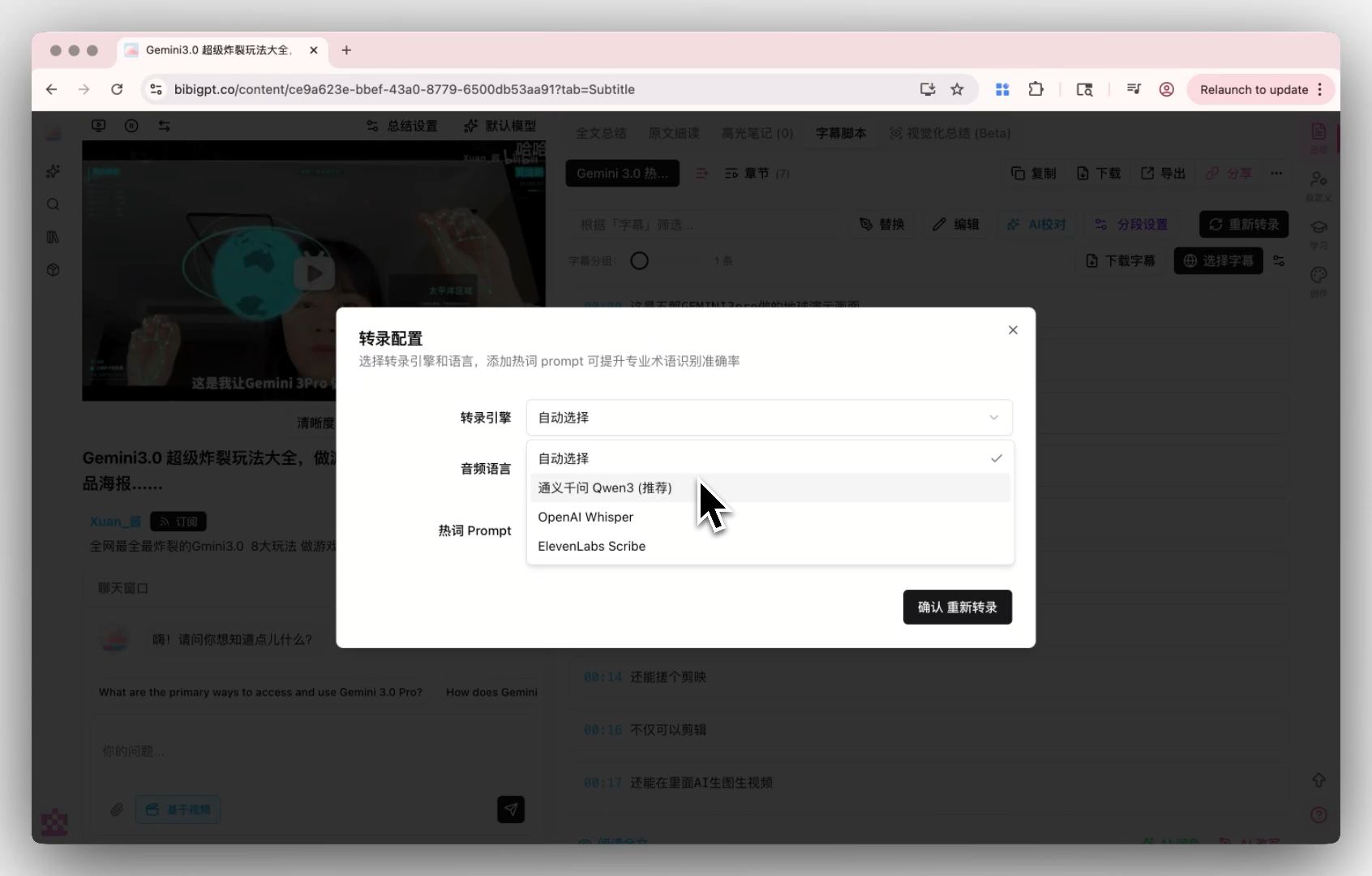
The image below shows where a “transcription engine” sits inside a finished tool — it’s just one link in a chain that also includes downloading, segmenting, summarizing, and exporting.
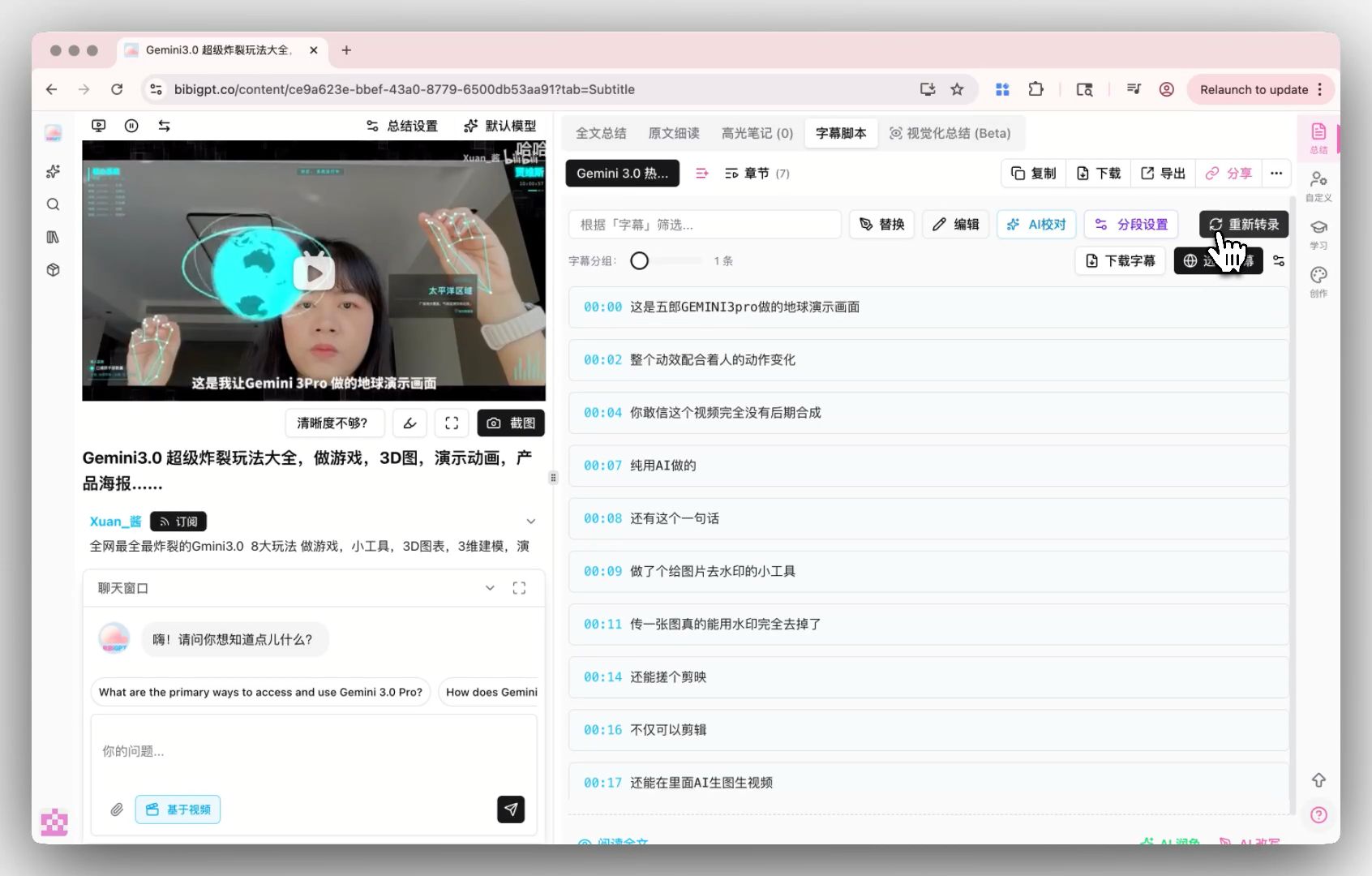
Screenshot: BibiGPT · Transcription engine settings entry
Transcription Accuracy: How Good Is That Eye-Catching Number Really?
The short answer: Grok STT’s claimed ~5.0% error rate is genuinely strong for phone-call entity recognition, but it comes from xAI’s own benchmark methodology, covers a narrow audio type, and says little about noisy long-form video or multilingual content. xAI’s official materials emphasize that Grok STT performs especially well on entity recognition in phone-call audio — with a claimed error rate of about 5.0%, alongside comparison figures for a few common services: ElevenLabs at about 12.0%, Deepgram at about 13.5%, and AssemblyAI at about 21.3% (data from the MarkTechPost report, based on their own self-reported benchmark methodology).
That number is genuinely eye-catching, but read it with three caveats in mind:
- This is a vendor self-benchmark: Any benchmark a vendor publishes will favor scenarios that flatter them. 5% is the result for entity recognition in phone-call audio specifically — it doesn’t mean that noisy podcast with background music and people talking over each other will also hit 5%.
- Entity recognition ≠ full-text accuracy: Entity recognition measures whether names, amounts, and places were heard correctly — that’s a different thing from “was the entire passage transcribed word-for-word correctly.”
- Chinese and dialects remain a variable: Across the 25 languages covered, real-world performance varies a lot by language, especially for content that mixes Chinese and English or is dense with technical jargon.
Practical rule: There’s no single number that captures transcription accuracy everywhere. What you should actually do is test your own three most typical clips — one clean voiceover, one noisy live recording, one mixed-language clip — and see how stable it is in your own use case.
For content consumers, what matters more than “word-for-word accuracy” is usability after transcription — whether the text is automatically segmented, searchable, and lets you jump back to a specific moment in the original.
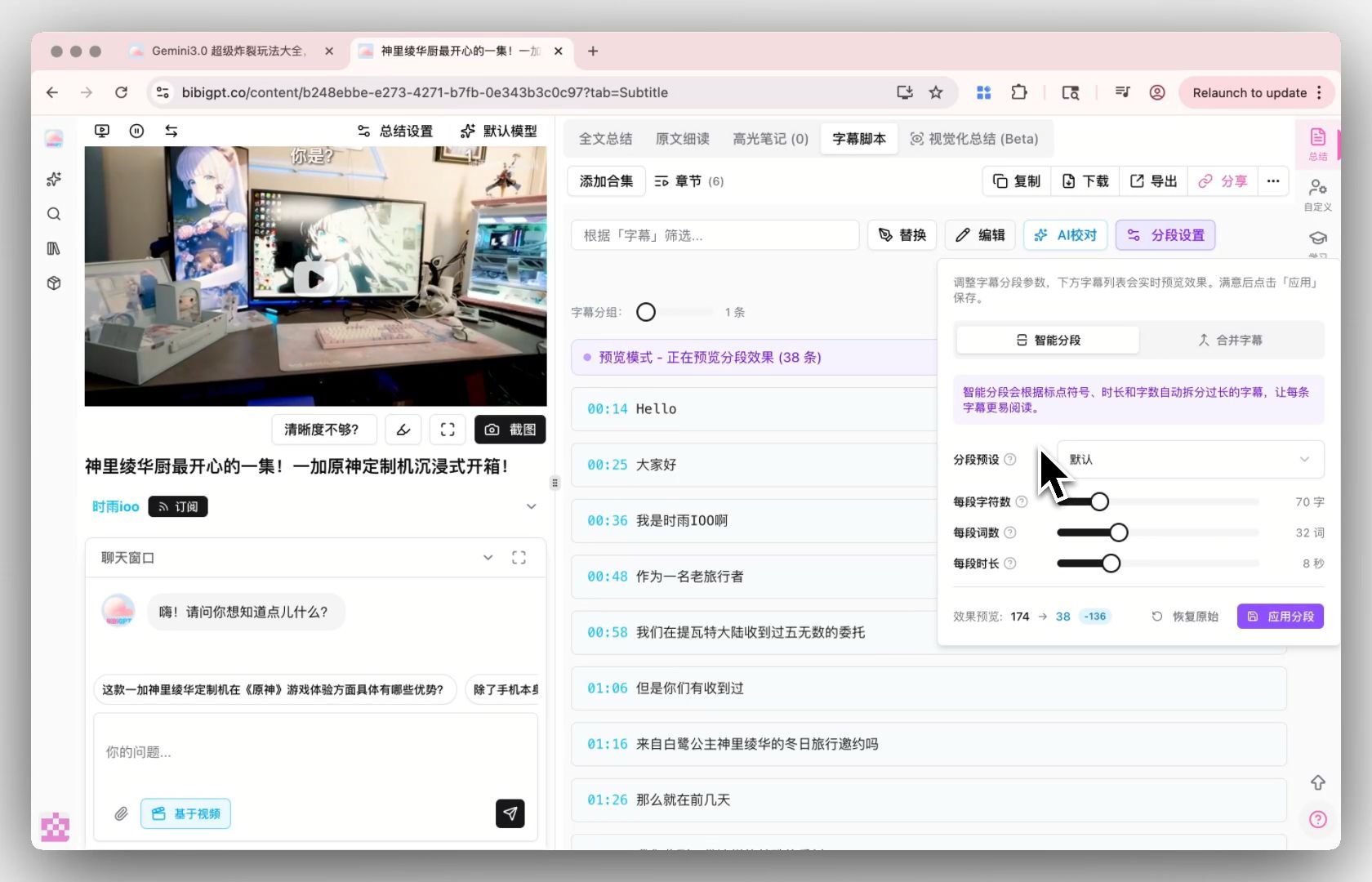
Screenshot: BibiGPT · Smart subtitle segmentation
Is a “Transcription Model” the Same as a “Transcription Tool”?
No — and this is the single most important point in this article. Models like Grok STT solve the “audio → text” step; what most people actually need is “a link → a usable finished product.” In between sits an entire pipeline:
| Step | Transcription model (e.g., Grok STT) | Finished tool (e.g., BibiGPT) |
|---|---|---|
| Getting the content | You need to download/record the audio yourself | Just paste a link, 30+ platforms supported |
| Converting to text | ✅ This is its strength | ✅ Built in, invisible to the user |
| Auto-segmentation / timestamps | Provides word-level timestamps, but you organize them yourself | ✅ Automatic chapters + clickable timestamps |
| Generating a summary / key points | ❌ Not done | ✅ One-click structured summary |
| Full-text search / jump back to source | ❌ Not done | ✅ Search and jump instantly |
| Export to notes | ❌ Not done | ✅ Export supported |
| Pricing | Billed by audio hours, you build the rest | Subscription, ready out of the box |
In one line: Grok STT is for “people who want to build a tool,” while a finished tool is for “people who want the result.”
Practical rule: If you process fewer than a few dozen hours of audio/video a week and don’t want to write code, then “buy a transcription API by the hour and build your own pipeline around it” is almost always more expensive and slower than “just use a finished product.”
For long-form audio like podcasts, whether you can search and pinpoint the exact minute a sentence was said usually matters more for efficiency than the transcription itself.
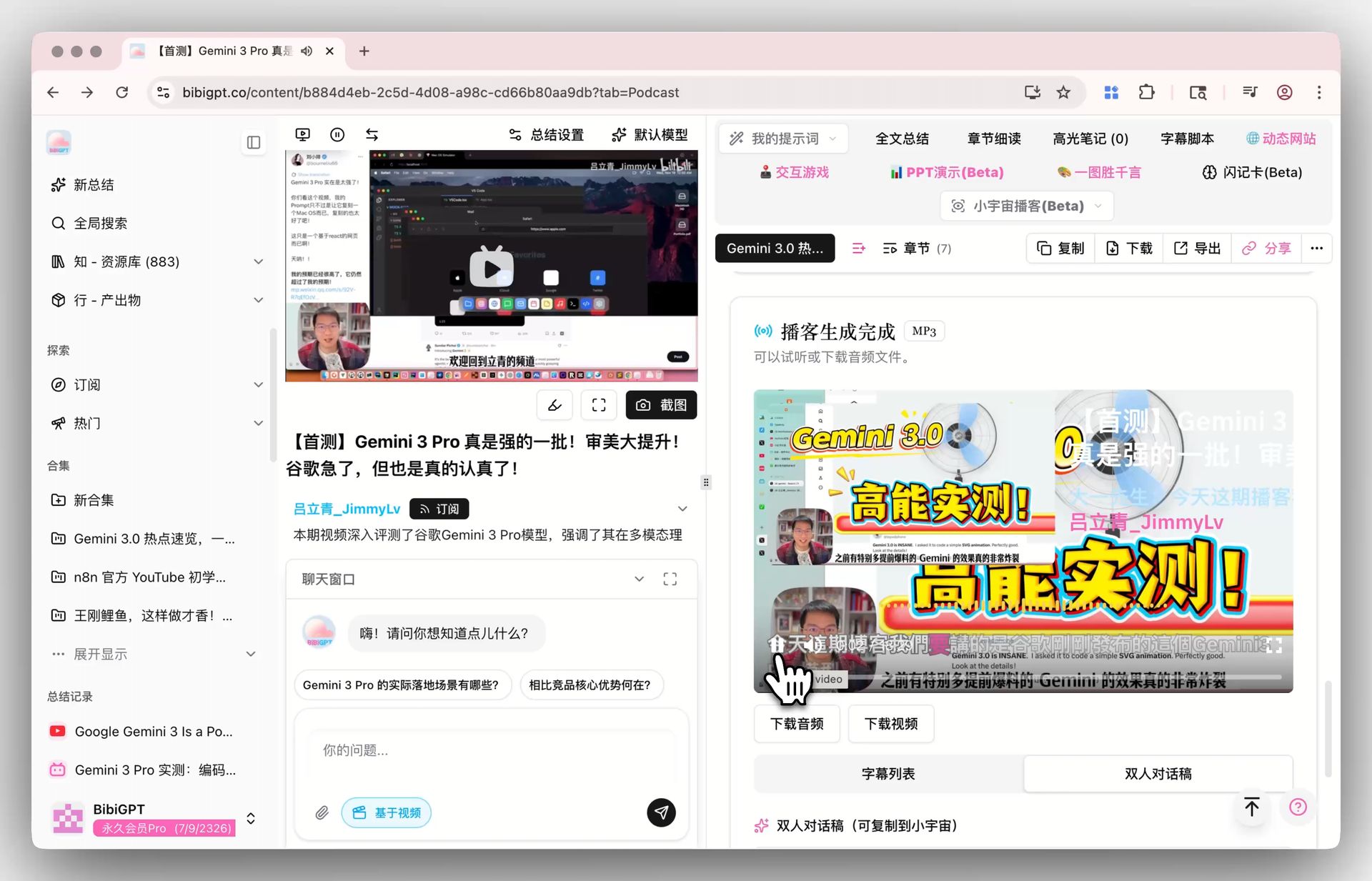
Screenshot: BibiGPT · Podcast transcription and summary
When to Use Grok STT, and When to Use BibiGPT
It’s not an either/or choice — it depends on which link of the pipeline you’re standing at:
- Choose Grok STT (or any transcription model API): You’re a developer embedding transcription capability into your own product; you have a large volume of your own audio files to batch process; you need deep customization of the transcription output.
- Choose BibiGPT: You’re a content consumer or creator who wants to watch videos faster, listen to podcasts faster, and turn content into usable notes; you don’t want to build a pipeline, manage an API, or pay by the hour.
BibiGPT isn’t just another “transcription model aggregator” — it’s a finished product that strings transcription, segmentation, summarization, search, and export into one complete pipeline. It has already served over 1 million users and generated more than 5 million AI summaries, covering 30+ mainstream audio/video platforms. Transcription is just one step in that pipeline that users never have to think about.
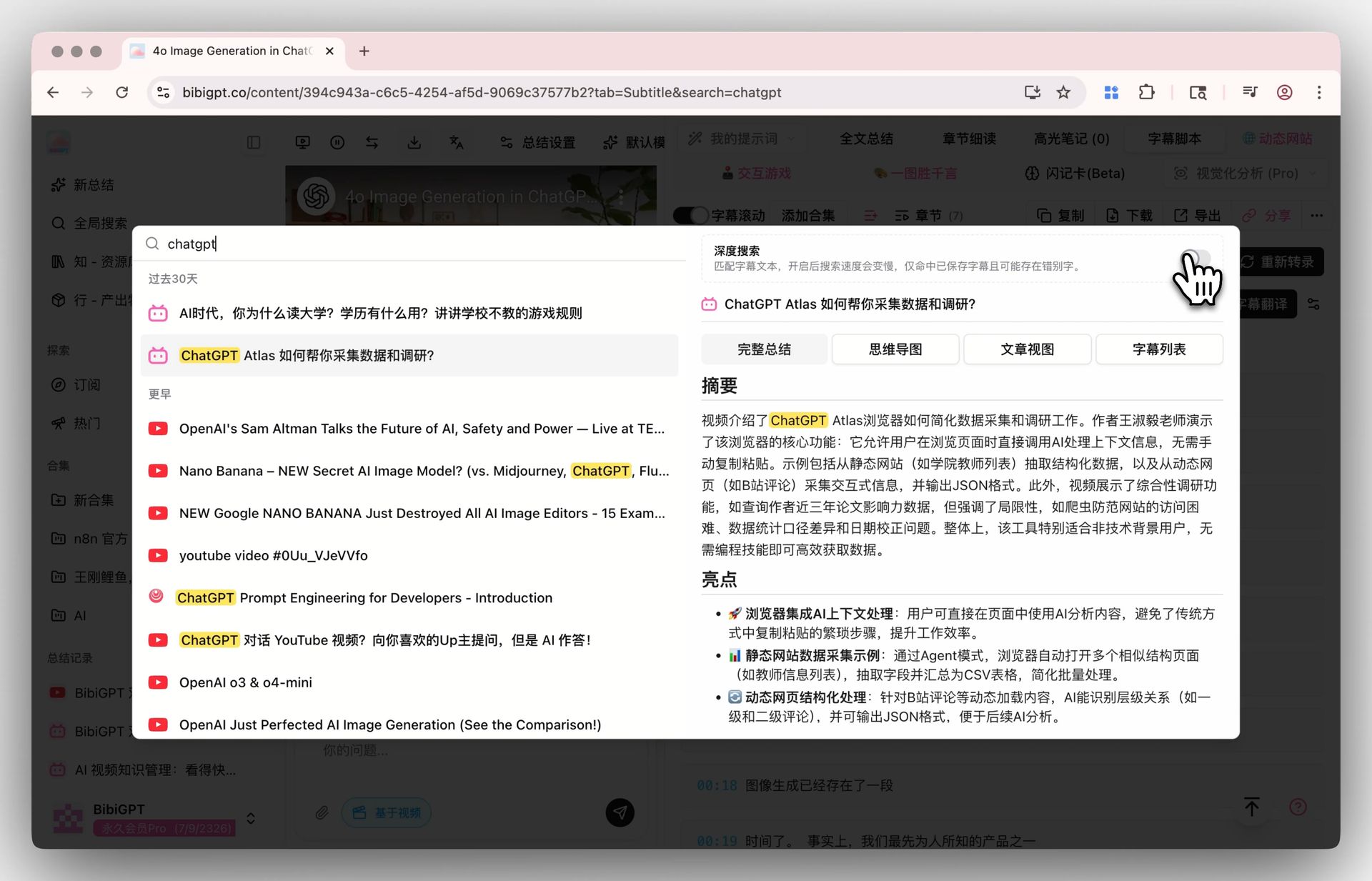
Screenshot: BibiGPT · Deep full-text search
In Practice: The Full Flow From a Link to Usable Text
Turning a video or podcast episode into usable text with BibiGPT usually takes just three steps:
- Paste the link: Paste a link from YouTube, Bilibili, Xiaohongshu, a podcast, etc., or upload a local audio/video file directly. See related features: free online speech-to-text and local file speech-to-text.
- Let it run: Within seconds, get timestamped text, automatically organized chapters, and a structured summary.
- Put it to use: Search the full text to find key sentences, click a timestamp to jump back to the original clip, and export to your own note-taking tool.
Once everything is organized, you can export the text, subtitles, and summary to your own note-taking tool in one click:
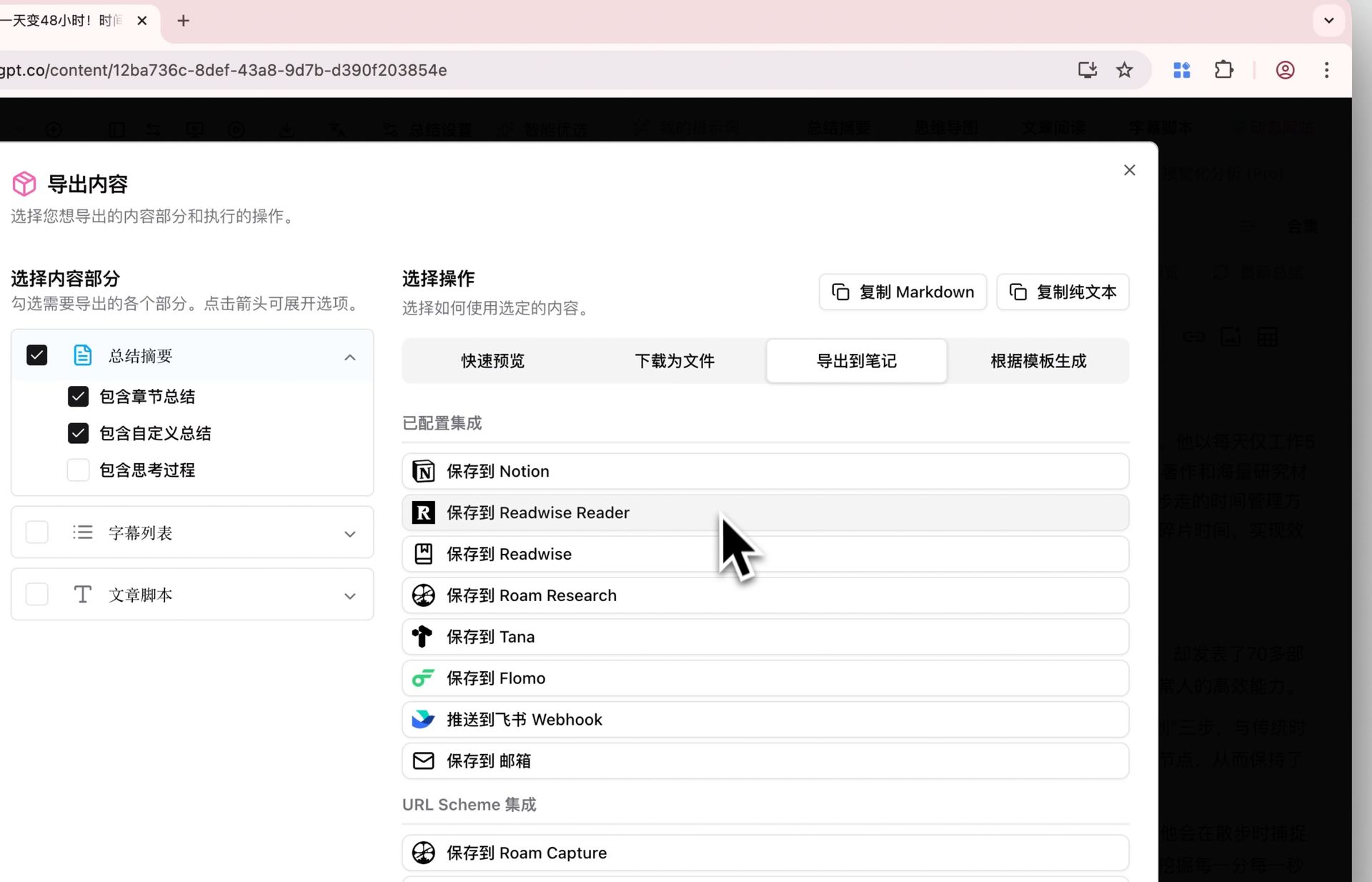
Screenshot: BibiGPT · Unified export panel
The demo below lets you experience the “link in, finished product out” flow directly:
Summarize any video in seconds
Pick a sample below to see the AI summary — TL;DR, key points, and jump-to timestamps.
TL;DR: Karpathy builds a GPT-style language model from scratch in code, explaining every piece — from a tiny character-level model up to the full Transformer.
Key points
- Start with a bigram model, then add self-attention so tokens can "talk" to each other
- A Transformer block = multi-head attention + feed-forward + residual connections + layer norm
- Training is just predicting the next token; scale and data do the rest
- The same architecture behind nanoGPT is what scales up to ChatGPT
Jump to
- 00:07 Why build GPT from scratch
- 08:23 Self-attention, intuitively
- 1:00:00 Assembling the Transformer block
- 1:35:00 From nanoGPT to ChatGPT
Practical rule: When judging whether a transcription approach fits your needs, don’t look only at the transcription step itself — factor in “what do I still need to do after I get the text.” For most people, the time sink is organizing after transcription, not the transcription itself.
Forecast: Transcription Is Entering the “Good Enough” Era
Based on current trends, here are three time-bound, falsifiable predictions (as of 2026-07-27):
- Within the next 12 months, transcription accuracy across the board will approach a ceiling: The gap between mainstream transcription models on clean speech will keep shrinking, and “who’s more accurate” will stop being the main selling point. If a year from now everyone is still fighting over decimal points of error rate, count this prediction wrong.
- Competition will shift from “transcribes accurately” to “what can you do after transcribing”: Whether it can search, summarize, and plug into your workflow will become the real dividing line.
- Pure transcription APIs will become infrastructure, and prices will keep falling: Just like cloud storage today, transcription will get cheap enough that nobody pays a premium for it alone — value will migrate up to the “finished experience” layer.
One line to close: Models are no longer scarce; consuming content faster is what’s scarce. Transcription will eventually be as available as tap water — what’s actually valuable is the pipeline that lets you watch videos and listen to podcasts as fast as you read text.
FAQ
Q: Does Grok STT 1.0 support Chinese? A: Yes. It covers about 25 languages, including Chinese. But real-world performance varies by language, especially for content mixing Chinese and English or dense with technical jargon — it’s worth testing with your own typical material.
Q: Are Grok STT and BibiGPT competitors? A: Not exactly. Grok STT is a transcription model for developers; BibiGPT is a finished tool for end users. The former solves “audio to text,” the latter solves “a link becomes a readable, searchable, usable finished product” — they sit at different points in the pipeline.
Q: Is it worth it for a regular user to use Grok STT directly? A: In most cases, no. You’d have to download the audio yourself, call the API, and then assemble the output into usable notes — plus pay by the hour. Unless you have development skills and heavy batch-processing needs, a finished tool saves you time and money.
Q: What metric actually matters for transcription accuracy? A: The entity-recognition error rate vendors commonly report only measures keywords, which isn’t the same as full-text word-for-word accuracy. What really matters is how stable it is in your own use case, plus usability after transcription (segmentation, search, jump-to-timestamp).
Q: Which platforms and files does BibiGPT support? A: Links from 30+ platforms including YouTube, Bilibili, Douyin, TikTok, Xiaohongshu, and podcasts, as well as uploaded local audio/video files.
Popular tools
More in this series
- Apple iOS 27 Opens Third-Party AI: The Era of Switchable Assistants Is Here — How to Choose for Audio and Video (2026)
- DeepSeek R1 + BibiGPT: A Practical Guide to AI-Powered Audio/Video Understanding in 2025
- DeepSeek-V4 est là ! BibiGPT livre quatre nouveaux modèles + contexte 1M dès le premier jour — le résumé vidéo & podcast par IA passe au niveau supérieur
- BibiGPT vs DeepSeek-V4 + Granite Speech Plus 2026: Self-Hosted Open Source vs Productized Stack
- Claude Opus 4.6 Agent Teams Are Here: How AI Agents Are Transforming Video Understanding with BibiGPT