Bilibili’s International Relaunch and AI Dubbing: Dub, Subtitles, or Summary?

You finally get a Bilibili link from a friend in Shanghai. Forty minutes of game commentary, danmaku flying, UP 主 talking at full speed. Last year the overseas path often died at sign-up: passport, identity document, then a feed that still assumed you could keep up in Chinese. This week the pitch is different. The international app is back, AI dubbing is on the store listing, and the promise is that you can watch without subtitles.
That promise is a product claim, not a viewing strategy. Hearing a video in English is not the same as knowing whether the video was worth forty minutes. This piece is not a generic roundup of dubbing tools. If you want that comparison, read the separate AI video dubbing and translation tools 2026 guide. This one is narrower: Bilibili went global with AI dubbing — how should overseas viewers actually consume B-station content: dub, subtitles, or summary first.
What actually shipped in the international relaunch
As of 20–22 August 2026, the dated facts are tighter than the headlines.
Engadget (2026-08-20, citing Semafor) and TechSpot (2026-08-22) report that Bilibili relaunched the international app. Android is live; iOS is described as coming. Overseas identity verification has been dropped. The feed is meant to mix global and Chinese content rather than keep two sealed worlds. Inven Global (2026-08-21) adds the hiring map: Los Angeles, London, Mexico City, São Paulo, Istanbul, and Tokyo. An English-language website is described as coming soon. The company’s own bilibili.com remains the Chinese-language home; do not confuse that live site with the English site that has not shipped yet.
The dubbing line is separate from the relaunch logistics. FandomWire (2026-08-21), citing the Google Play listing, quotes Bilibili’s AI Dubbing as a way to watch creators without needing subtitles. Treat any Crunchyroll comparison as optional and cautious: a store sentence about watching without subtitles is not the same as a licensed anime catalog war.
On language coverage, stay inside what Chinese-language coverage actually said. As of August 2026, Sina and similar reports describe Bilibili’s AI original-voice translation as currently Chinese–English, with more languages planned. They also talk about voice and lip-sync. That is a platform claim about playback. It is not a language-count you should inflate, and it is not a reason to assume Japanese, Korean, or a dozen other tracks are already in the product.
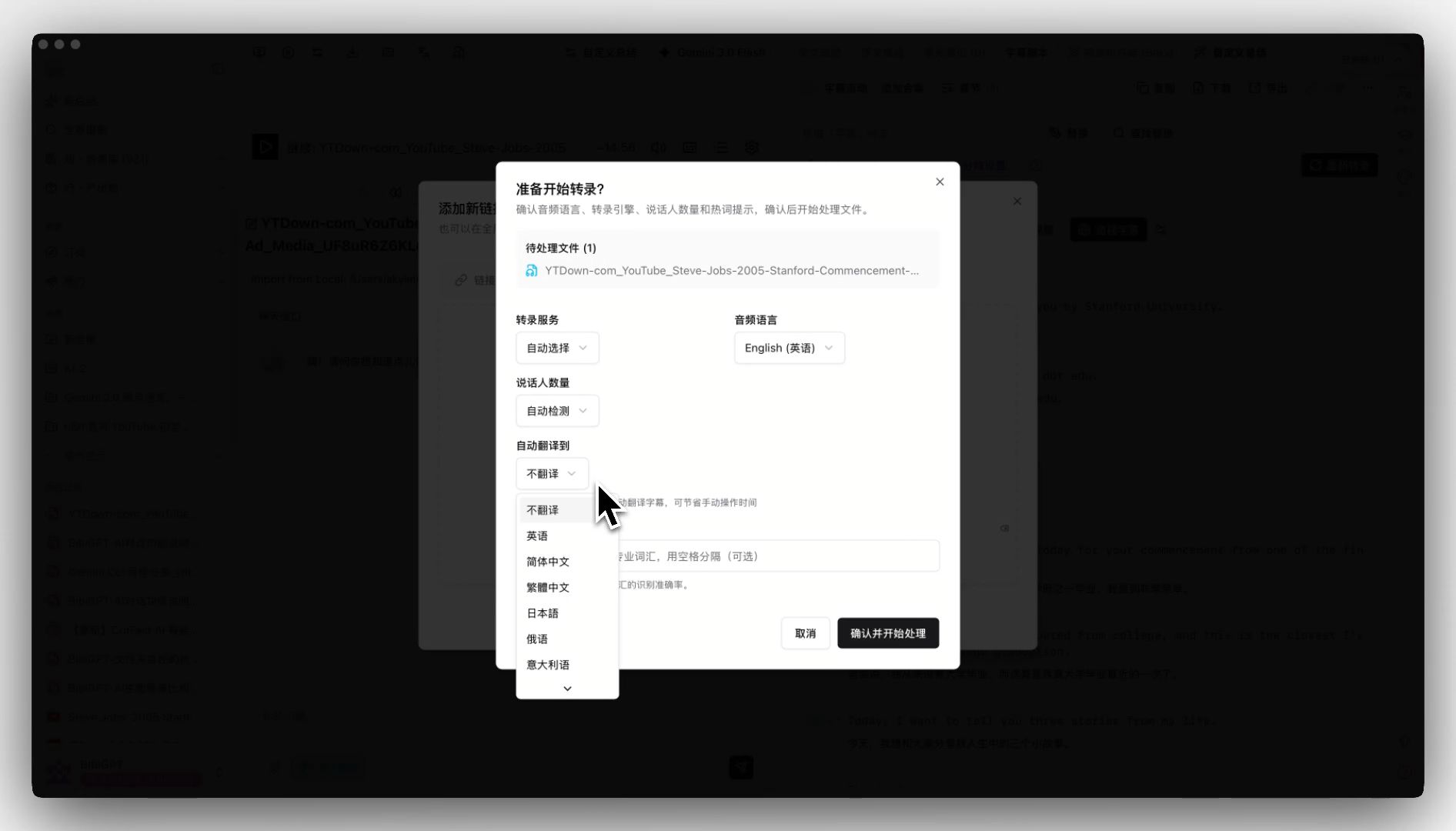
The screenshot below is the kind of upload-time translation entry a viewer actually needs after the headline fades: not a dubbed trailer, a place to decide whether the clip is knowledge or vibe.
Screenshot: auto-translate on upload entry. Source: BibiGPT. This is subtitle and translation, not lip-sync dubbing.
Practical rule: Date-stamp platform claims. Android live, iOS coming, English site coming soon, and Chinese–English dubbing as of August 2026 are facts. “Global AI dubbing in every language” is not.
AI dubbing vs subtitles: different jobs
AI dubbing, subtitles, and a summary are three jobs. Mixing them is how people waste an evening.
Dubbing replaces the soundtrack. You watch with your eyes on the frame and your ears on a target-language voice. The job is immersion: you do not want to read. That is what the Play listing is selling. Lip-sync, if the platform actually ships it on a given video, is part of that immersion job. It is not a note-taking job.
Subtitles keep the original voice. You hear the UP 主’s timing, jokes, and breath, and you read a translation. The job is fidelity plus comprehension. For ACG terms, game jargon, and lecture definitions, the written line is often the only thing you can pause and search.
A summary does not ask you to watch first. It compresses the video into takeaways, chapters, and timestamps so you can decide whether the dub or the subtitle track is worth opening at all. That is a judgment job, not a playback job.
Bilibili’s international pitch is the first job. Most overseas viewers who actually need B-station — students, researchers, people following a specific UP 主 — spend most of their time in the second and third jobs. A dubbed track can make a clip feel watchable. It cannot tell you that minutes 11–14 were the only part that mattered.
See the screenshot below for the matching question after a long clip: not “did the voice sound native,” but “what should I ask this video before I give it another forty minutes.”
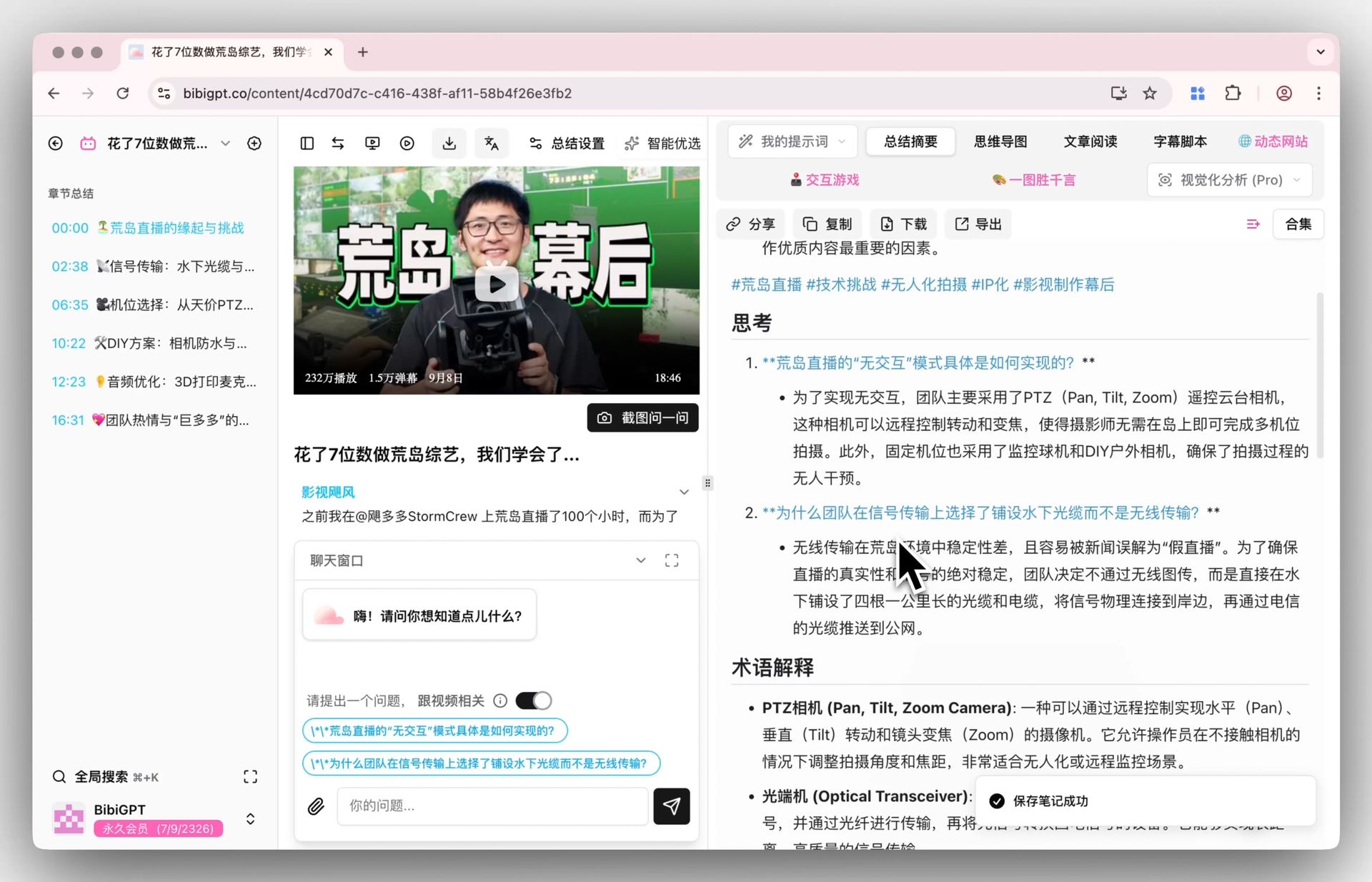
Screenshot: deep-summary questions on a long video. Source: BibiGPT.
Practical rule: If you cannot name the job — vibe, verbatim, or verdict — do not pick a playback mode yet. Dubbing is vibe. Subtitles are verbatim. A summary is the verdict on whether to watch.
Who this helps
Three groups feel this relaunch immediately. They do not need the same button.
Overseas viewers who bounced off identity verification now have a lower sign-up wall. Android is the door that actually exists today. That helps if you wanted to browse mixed Chinese and global feeds without mailing a passport scan. It does not automatically help if your problem was never sign-up — it was a two-hour 高考-style lecture, a lore dump, or a speedrun commentary you cannot follow at native pace.
UP 主 going global get a distribution story: same content pool, less ID friction, localization as a talking point. If you already publish on Bilibili and want non-Chinese viewers, AI dubbing is a discovery aid. It is not a substitute for a transcript you can hand to an editor, or for chapters a collaborator can jump. Creators who only ship a dubbed file still cannot search their own backlog six months later.
Anime, game, and ACG commentary viewers are the group most likely to hear a Crunchyroll comparison. Be careful. Bilibili is a UGC and commentary ocean with official seasons in the mix; it is not, on the evidence published this week, a drop-in replacement for a licensed anime subscription. What it is good at is the surrounding layer: UP 主 explaining a patch, a boss, a character, or a meme. Those videos are exactly where dubbing sounds exciting and where jargon dies first.
Prefer to watch the tension instead of reading it? The clip below is a public YouTube example of the same “do I watch this long video, or do I need a way through it first” problem. It is not a Bilibili product demo.
Source: YouTube. Public clip used to show the watch-first versus read-first tension, not as an official Bilibili trailer.
Bilibili itself started as a place to watch, not a place to read. The early product surface below is the reminder: the homepage is still a video feed. Dubbing changes the soundtrack. It does not change that job.
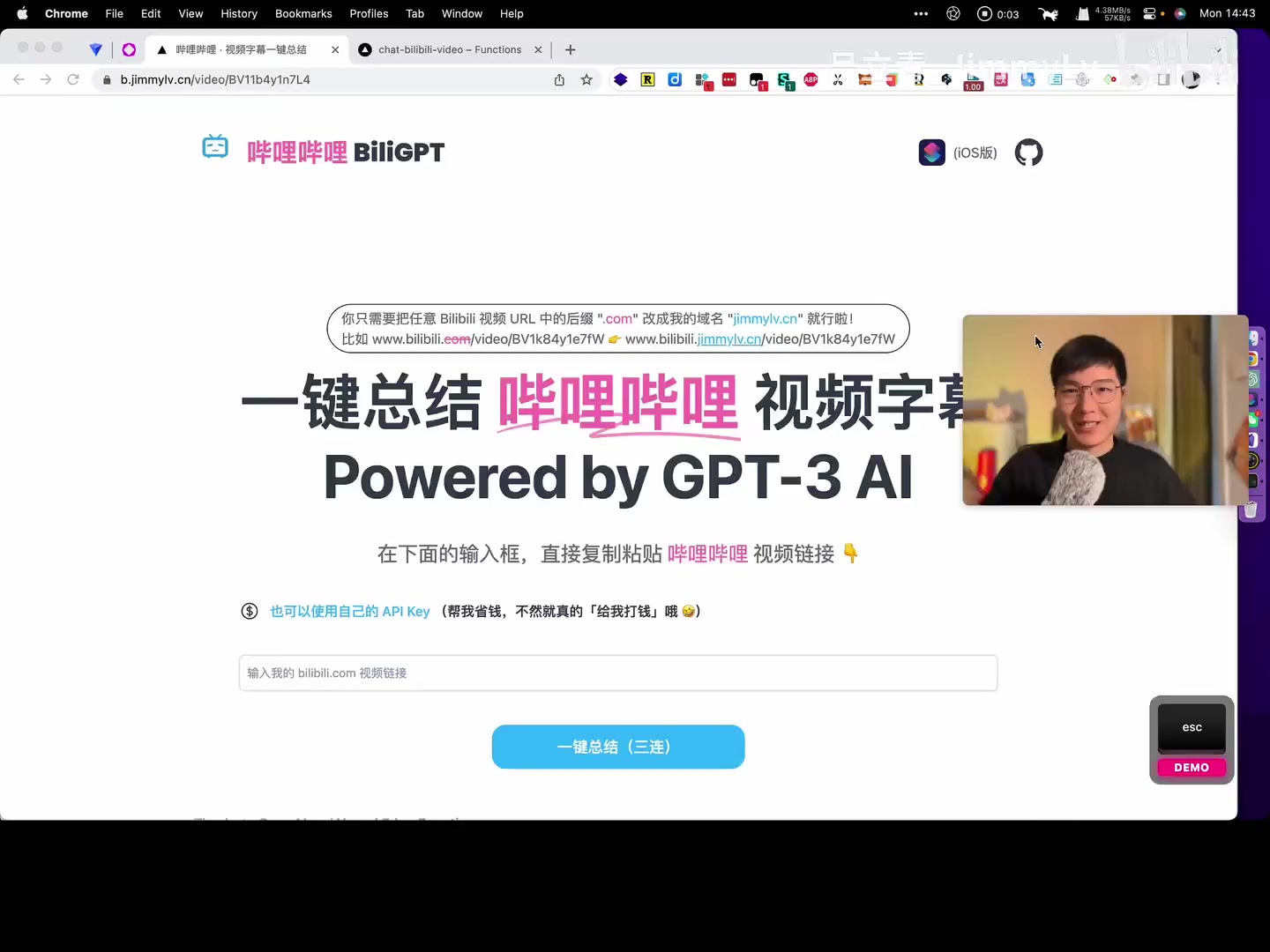
Historical product screenshot: summarizing Bilibili videos from a homepage paste box — still a watch-or-summarize choice, not a dubbing studio.
Where dubbing still fails
Dubbing fails in predictable places. None of them require a conspiracy; they are just the wrong job.
Jargon. Game patches, medical explainers, and CS lectures live in terms. A dubbed voice will often pick a fluent-sounding English word that is not the word the community uses. You then cannot search it, cannot paste it into a wiki, and cannot tell whether the UP 主 was citing a specific skill name or just chatting.
Jokes and danmaku timing. B-station humor is often a stack: the UP 主’s line, a visual punch, and a danmaku pile-on. Swap the voice, stretch the lip-sync, and the stack slips. You still “watched.” You did not get the joke.
ACG terms. Character names, skill names, and fandom shorthand are brittle. As of August 2026, original-voice translation is currently reported as Chinese–English, with more languages planned. Even inside that pair, a proper noun that should stay in Japanese romanization or Chinese pinyin can get flattened into a generic English gloss. That is fine for vibe. It is poison for a glossary.
Long lectures. A forty-minute classroom upload does not become a twenty-minute English classroom because the voice changed. You still have to sit through the warmup, the recap, and the tangents. Dubbing makes the sitting more comfortable. It does not tell you where the definition was.
The screenshot below shows why a segmented subtitle track still matters when the dubbed voice sounds smooth: you need lines you can scan, pause, and copy, not only a soundtrack you can play.
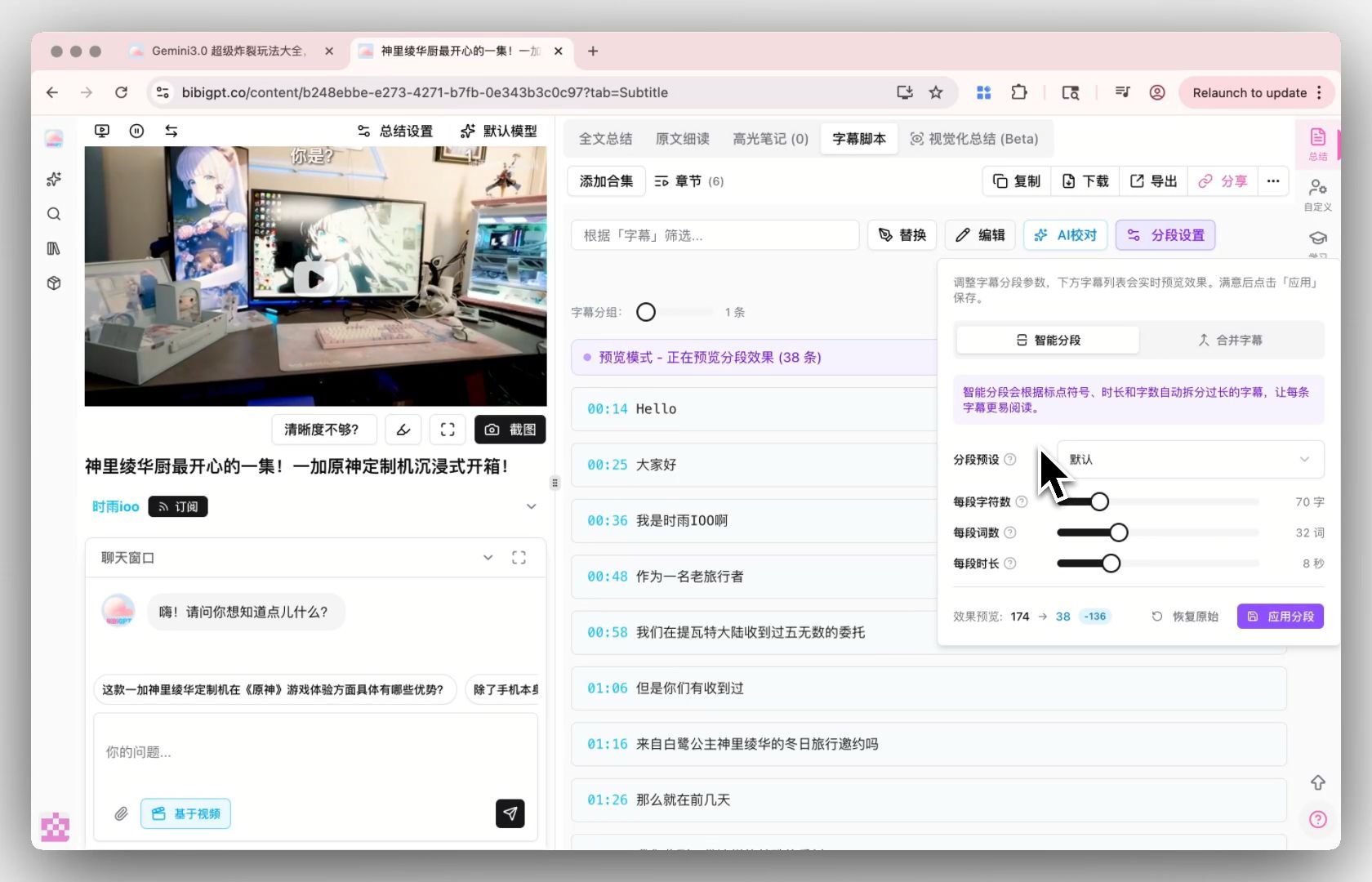
Screenshot: subtitle segmentation entry. Source: BibiGPT. Readable lines, not a replacement voice.
Practical rule: When the video is longer than fifteen minutes, or denser than a trailer, treat dubbing as a comfort layer. Comfort is not comprehension. If you cannot quote a timestamp, you do not have the knowledge yet.
A better overseas workflow: dub for vibe, summary plus timestamps for knowledge
The judgment ends here. The rest is a workflow, not a slogan.
Use Bilibili AI dubbing when the job is vibe: a short ACG clip, a funny UP 主, a music or lifestyle video where you want your eyes on the frame. Use the international Android app for that, and accept that language coverage as of August 2026 is currently reported as Chinese–English, with more languages planned.
Use subtitles plus a summary when the job is knowledge: lectures, patch notes, long game commentary, research talks, anything you might cite next week. BibiGPT does not do lip-sync dubbing. It will not clone an UP 主’s voice onto your timeline. What it does is the other half of the relaunch problem: paste a Bilibili link, get a transcript, bilingual subtitles, a structured summary, and jumpable timestamps, then export an article if you need something searchable.
A practical sequence:
- Do not start by watching the dubbed forty minutes. Paste the Bilibili URL first.
- Read the summary and chapter list. Decide in two minutes whether the video is vibe, knowledge, or skip.
- If it is knowledge, open AI Bilibili summary or Bilibili video to text and keep the original timestamps.
- Jump only the three minutes that matter. Use the dub or the original audio there, not for the whole file.
- If you also live on YouTube explainers, keep the same habit with AI YouTube summary so B-station and YouTube do not become two different brains.
The interactive demo below is that judgment step: paste a link, get a structured summary, then decide whether a dubbed watch is even warranted.
Summarize any video in seconds
Pick a sample below to see the AI summary — TL;DR, key points, and jump-to timestamps.
TL;DR: Karpathy builds a GPT-style language model from scratch in code, explaining every piece — from a tiny character-level model up to the full Transformer.
Key points
- Start with a bigram model, then add self-attention so tokens can "talk" to each other
- A Transformer block = multi-head attention + feed-forward + residual connections + layer norm
- Training is just predicting the next token; scale and data do the rest
- The same architecture behind nanoGPT is what scales up to ChatGPT
Jump to
- 00:07 Why build GPT from scratch
- 08:23 Self-attention, intuitively
- 1:00:00 Assembling the Transformer block
- 1:35:00 From nanoGPT to ChatGPT
When you do need to take the notes with you, the screenshot below is the download end of an article export — a file you can search next month, which a dubbed stream will not give you.
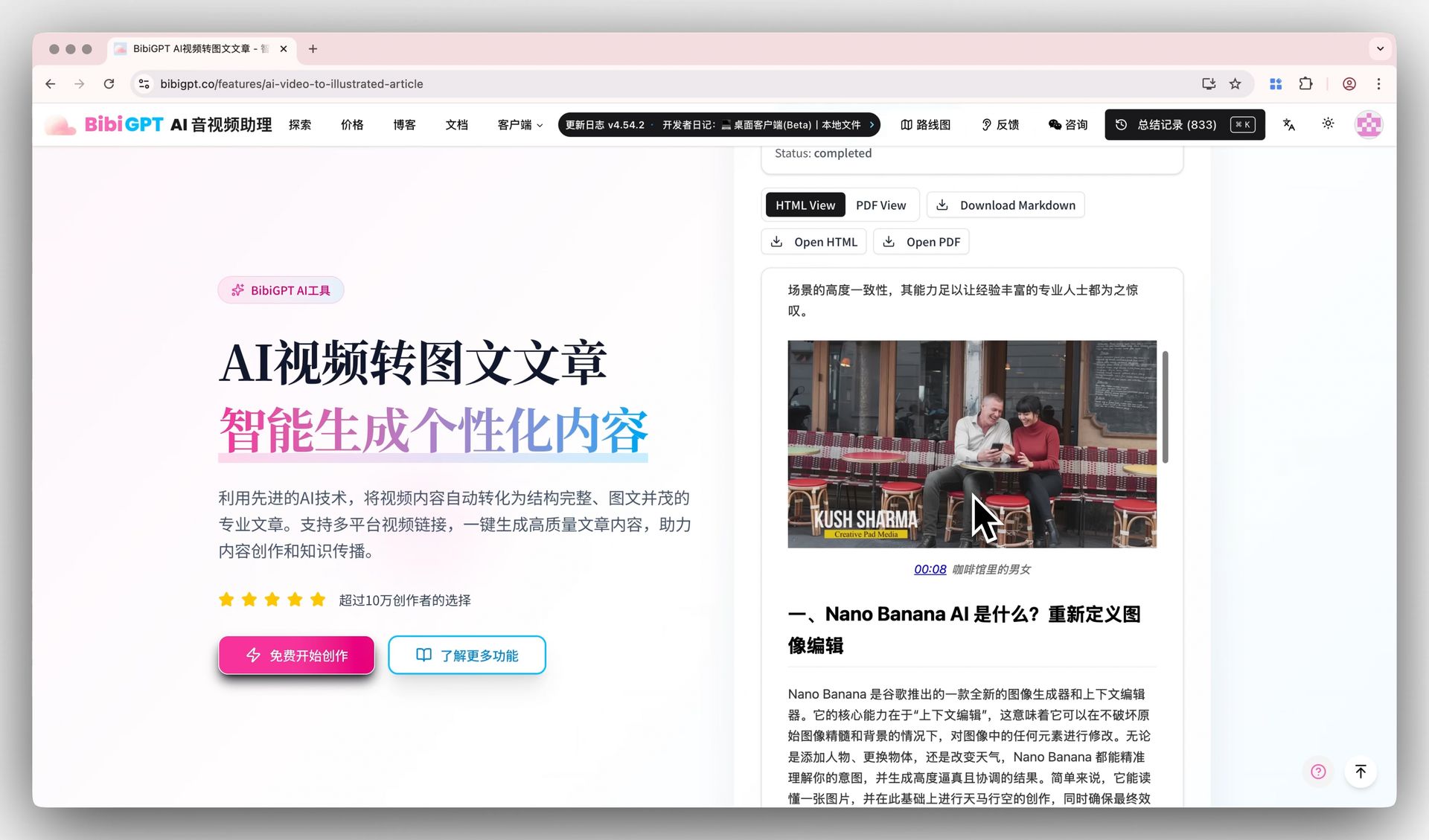
Screenshot: video-to-article download control. Source: BibiGPT.
You can try that path on BibiGPT with one of your own B-station links. The product limit stays honest: summary, subtitles, translation, article — not lip-sync dubbing.
Practical rule: Dub for the clip you would watch on a sofa. Summarize for the clip you would cite in a note. If you cannot tell which sofa you are on, generate the summary first and let the timestamps decide.
What to watch next
Three public promises are still open, and they are not BibiGPT features.
iOS international app. Coverage this week repeats “iOS coming.” Android is the only client independently described as live. Falsifiable check: if the iOS international app is not publicly available by 2026-10-31, the “iOS coming soon” line was marketing, not a dated shipping plan.
English website. Engadget, TechSpot, and Inven all relay “coming soon.” Until a public English site exists, treat bilibili.com as the live Chinese site and the English web as unreleased. Do not bookmark a URL that has not been published.
More dub languages. As of August 2026, original-voice translation is currently reported as Chinese–English, with more languages planned. A later Japanese or Korean track would change the vibe layer for ACG viewers. It would still not replace timestamps for lectures.
None of those dates is a promise that BibiGPT will add dubbing, lip-sync, or a Bilibili-official voice clone. If those platform pieces slip, the overseas workflow above still holds: summary first, watch second, dub only when the job is vibe.
FAQ
Is the international app on iPhone yet? As of 20–22 August 2026, reporting says Android is live and iOS is coming. There is no public iOS ship date in the sources above. Use the 2026-10-31 check in the previous section.
What languages does Bilibili AI dubbing support? Treat August 2026 coverage as: currently reported as Chinese–English, with more languages planned. Do not assume a long language list until Bilibili publishes one.
Is this a Crunchyroll rival? Only in the loosest sense that both touch anime-adjacent viewing. This week’s facts are an international app, easier sign-up, mixed feeds, and an AI dubbing line on the store listing. That is not the same as a licensed catalog comparison. Keep the comparison optional and cautious.
Does BibiGPT lip-sync or dub Bilibili videos? No. BibiGPT summarizes, transcribes, translates subtitles, and turns videos into articles. Lip-sync original-voice dubbing is a Bilibili platform claim, not a BibiGPT feature.
I only want to “watch without subtitles.” Do I still need a summary? If the clip is short and the job is vibe, the platform dub may be enough. If the clip is a lecture, a patch breakdown, or anything you might reuse, generate a summary and timestamps first. Watching without subtitles does not create notes.
Do overseas viewers still need identity verification? Reporting this week says the international relaunch dropped that requirement. That is a sign-up change. It does not change how you should consume a forty-minute video.
The relaunch makes B-station easier to open. It does not decide the job. For knowledge, start with a summary; for vibe, take the dub. To run one of your own links, use BibiGPT.
Start with a Bilibili link, not a dubbed guess:
- Website: https://bibigpt.co
- Bilibili summary: AI Bilibili summary
- Bilibili to text: Bilibili video to text
- YouTube counterpart: AI YouTube summary
BibiGPT Team
Popular tools
More in this series
- AI Competitive Intelligence Workflow: Build Industry Monitoring with BibiGPT Video Summaries
- Lessons From Shipping BiliGPT: Two Cold-Start Growth Tactics Behind a GPT-3 Side Project
- [BibiGPT Growth Series] Episode 1 | How AI Summaries for Bilibili Were Born
- BibiGPT Advanced Guide 2026: Download + AI-Summarize Videos from WeChat Channels, RedNote, TikTok, and Enterprise Intranet Sites
- Chat with Any Video: How to Ask AI Questions About Videos Instead of Watching the Whole Thing (2026)